

Himal Southasian has an excerpt from Speaking of History (reproduced below). Three previous excerpts have appeared in The Wire, The Print, and Scroll. Check ’em all out!
Romila Thapar on the emergence of a common Indian identity
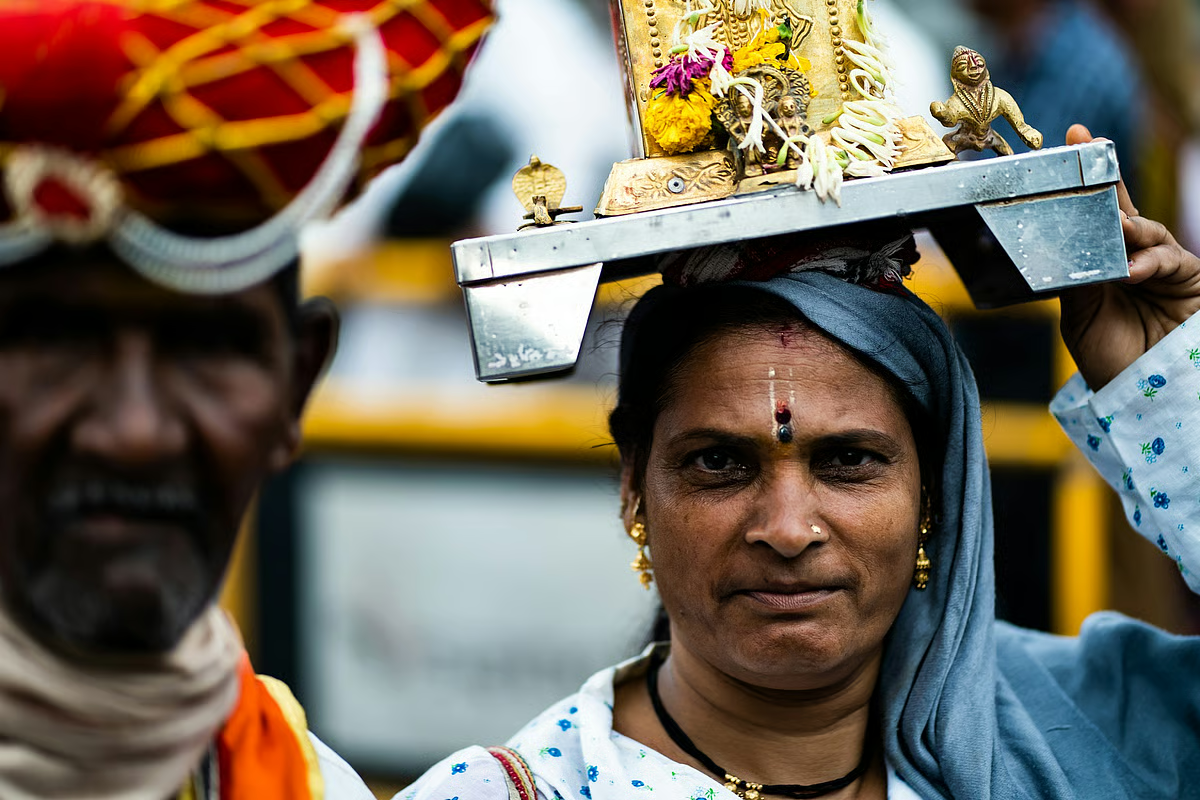
Namit Arora and Romila Thapar on how identities in early and medieval India were formed, contested, and why a shared sense of “Indianness” may be a colonial-era development.
What did it mean to be “Indian” before the modern nation came into being? In this excerpt from Speaking of History: Conversations about India’s Past and Present (Penguin India, Nov 2025), the historian Romila Thapar and the writer and social critic Namit Arora reflect on how identities were formed, imagined and contested in early and medieval India. Ranging across foreign travel accounts, Sanskrit texts, caste hierarchies and colonial transformations, the conversation probes whether any shared sense of Indian identity existed prior to the colonial era, and why the question itself has become so politically charged today.
NAMIT: Let me move on to the matter of Indian identity. Over the centuries, many foreign travellers passed through India: Megasthenes, the Chinese monks, Alberuni and others. These travellers noticed a cultural distinctiveness about the subcontinent, and called its inhabitants Hindus—then a non-religious term for all peoples east of the Sindhu River in al-Hind. They saw them as different from people elsewhere in the world, though their perceptions were seemingly based on their interactions with the dominant and literate groups, or the ‘visible people’ of the time—elite groups who created texts, monuments and other durable artifacts.
But did Indians themselves broadly share any sense of a common identity, whether religious or secular, in early or medieval India? Did they see themselves in any sense as ‘us here’ versus ‘them outsiders’, roughly aligned with subcontinental boundaries? If not, when did the first semblance of such a common identity emerge across India, at least among a significant subset of its people?
ROMILA: If you speak in subcontinental terms, I would say very late. Megasthenes doesn’t mention the similarity all the way across. He refers to different groups, different practices, makes a distinction between them. The Chinese pilgrims are Buddhist monks, and India is for them the western heaven, the holy land of the Buddha. This is where the Buddha was born and lived, so they are in awe of India. Alberuni is very practical. He is interested in Brahmanical culture almost as what today we might call an anthropologist because he is a scholar, and he regards the observations of this culture as part of his scholarly interests. He is trying to understand it, not just record it.
When one reads about people coming to India, one has to ask who they are, and what they are pursuing in India. We don’t know for sure. Possibly the most rational, logical perceptions come from Alberuni, but then that’s because his intellect is extraordinary. It’s not that the Chinese pilgrims didn’t have high intellect, but their purpose and function was to pursue their interest in Buddhism—not the same as that of Alberuni or Megasthenes. The Greeks were curious; they didn’t think the Indians were superior to them but just different. And so their whole attitude was: Let’s record the strange differences we see or hear about here, such as the story of a man who had such long ears that at night he curled up and slept in them. Their descriptions of first-hand observations are more to the point. In his account, Megasthenes refers in some detail to the seven subdivisions of Indian society. This is interesting as a perception of an outsider of how Indian society—or at least its upper sections—was structured. So these are differences that have to be understood by us as recording how he saw the working of Indian society.
A common identity has a reason—why was it required? There was little reason for it in those days. The local boundary may have mattered but the distant one hardly did. Then there is the question of what that identity might have been? If the common factor was belonging to a kingdom, then these changed their boundaries, sometimes from reign to reign, so what was the territorial definition? I am raising the question of territorial definition because one’s home territory was obvious, easily identified and known. The other evident identity would have been that of the cultural pattern of the elite which would have been similar at least in adjacent regions. Those of lesser status would doubtless have followed diverse local patterns.
NAMIT: So when does a sense of common identity emerge among Indians? These foreign travellers noted many differences within the subcontinent, but they also spoke of its residents collectively, suggesting that the travellers saw them as a distinct set in some ways, based on resemblances running across, at least among the visible people. However, if most inhabitants of the subcontinent did not possess a common or unifying identity, what were some leading criteria by which they separated themselves from others in ancient India?
ROMILA: Well, the more exclusive Indians had a sense of people who were different from ‘us’ and they put ‘them’ down as mleccha. Those who lacked a varna and didn’t observe the rituals were mleccha. The ‘us’ referred to the upper castes. Society, in any case, was sharply divided into the savarna and the avarna, so where was the factor of unity?
NAMIT: The same set of exclusive northern Indians also referred to people in other regions of the subcontinent as mleccha, including some people south of the Vindhyas, right?
ROMILA: Yes, it was based on a superior–inferior feeling. Upper-caste people saw other groups as not cultured to the same level as themselves. They didn’t use the words ‘civilized’ or ‘non-civilized’ but implied the latter by saying that ‘they don’t have the same observances as us; they are different, not to be emulated or trusted’. So they are mleccha. Having or not having a varna status becomes a crucial issue by the mid-first millennium CE.
As regards seeing themselves, their own sense of identity, there is mention of Aryavarta, the land of the Aryas. Who do they mean? Aren’t they referring to only the upper caste? Why are they leaving the others out? That’s a very deliberate cutting off. There are no clear boundaries. Does Aryavarta extend from the northern mountains to the Vindhyas? It is said to be between the two oceans, so is it between Sindh and Bengal, or between Kerala and Tamil Nadu? That’s not clearly defined, it’s vague. It’s the same with Bharatavarsha and Jambudvipa. The geography is neither clear, nor consistent.
It seems to me that a sense of unity within the subcontinent begins perhaps with the European colonial conquest. Maybe a little earlier? The Marathas, for example, are all over the place—in the Punjab, UP, Bengal, Tamil Nadu, though briefly in some places. But are they seeing all this as one land and one people? I don’t think so. I think they are seeing it as conquering different kingdoms and cultures, not as anything consolidated. But I really don’t know enough about eighteenth-century history to be able to answer that question. I think that the sense of Indianness pervading the subcontinent, as a uniformly recognizable identity, is a colonial-era development.
NAMIT: I think so too. Prior to that, in early and medieval India, identities were largely fragmented—shaped by region, language, kinship, religious sect, tribe, varna, jati, or combinations of these and more. However, a few scholars, such as Shonaleeka Kaul and Aloka Parasher Sen, hold that there was a shared civilizational identity in this period. They point to Sanskrit texts whose authors seem conscious of cultural commonalities across the subcontinent, as well as to certain shared customs and the popularity of epic stories.
I remain unconvinced by such reasoning. To begin with, these same Sanskrit texts, as B.D. Chattopadhyaya argues in The Concept of Bharatavarsha and Other Essays, express a far stronger consciousness of diversity and difference than of unity or commonality. Further, even if some Sanskrit texts reflect an awareness of cultural commonality among a section of the Brahmanic or Shramanic elite across the subcontinent, that awareness was not shared by the broader population. This elite may have noted recognizable cultural patterns across this land and noted its geographical edges—just as some foreign travellers described the subcontinent as culturally distinct from other lands—but that alone need not translate into a common identity felt by a multitude of its people.
I mean, what we often forget is that even widely shared cultural practices—such as doing pujas, fasting or going on pilgrimages—need not, by themselves, generate a collective identity or a sense of community. Today, millions of Indians cook curries, play cricket, or wear kurtas—but do any of these activities create a unifying identity or a shared national consciousness? Likewise, a shared set of stories does not ensure a shared identity. Take the case of Biblical lore. Did it manage to produce a significant common identity between the converted Quechua people of Peru and the Spaniards of Valencia? Far from it, because other, larger cultural and structural impediments came in the way.
Such impediments existed all along in the subcontinent. In fact, certain shared cultural practices—such as following the system of varna and jati—actively undermined any potential for a broad-based, inclusive cultural identity. The notion that our ancient ancestors felt a sense of ‘unity in diversity’ strikes me as a projection of modern Indian nationalism, forged by early twentieth-century Hindu revivalists such as Radha Kumud Mookerji. Claiming ancient roots for this idea essentially served to legitimize their vision of the nation. I wonder why it’s almost always Brahmin scholars who see such a unifying ‘civilizational identity’ (laughs)!
A more cohesive identity sometimes arises in opposition to a well-defined ‘Other’, but prior to the anti-colonial movement, there was no widely held or stable conception of ‘the Other’ aligned with subcontinental boundaries. So in pre-modern India, then, we seem to have had multiple, overlapping and shifting local identities, but no sense or basis of a widespread identity or unity, as in ‘we are all Indians / one people in this land’.
ROMILA: I haven’t come across a clear definition of the entire population, from the lowest to the highest, as Indians in Sanskrit sources.


Leave a Reply