
Category: History
-
Namit Arora in conversation with Jugnu Mohsin
I recently spoke to the acclaimed, fearless, and spirited Pakistani journalist Jugnu Mohsin, host of the video podcast Jugnunama, about a range of topics spanning history, politics, and society. Check it out!
-
Scroll’s email interview with Romila Thapar and Namit Arora

Namit Arora and Romila Thapar. Photo: Raghav Kakkar (@ Scroll.in) I’ve taken the liberty of reproducing below an email interview with my friend Abdullah Khan, published by Scroll. Abdullah is a Mumbai based novelist, screenwriter, literary critic, banker, and author of Patna Blues and A Man from Motihari. Thank you, Scroll!
‘Making procedures visible helps clarify how historical interpretations are formed’: Romila Thapar
In an email interview for Scroll, Historians Romila Thapar and writer Namit Arora respond to questions by Abdullah Khan about their book Speaking of History: Conversations about India’s Past and Present. They discuss how historical knowledge is produced and why method matters, the discomfort with ambiguity in public understandings of the past, and the ways in which political and cultural pressures shape historical narratives.The historians also spoke about the limits of evidence in recovering non-elite histories, the changing meanings of terms such as “Hindu” and “Sanatan,” and the challenges of writing and communicating history in an age of social media and artificial intelligence.
-
Why is there so much history in today’s politics?

Namit, Romila, and Shoaib on interview day, 24 March ’26. Photo: Raghav Kakkar Just out! Another interview featuring me and the inimitable Romila Thapar (1:10 hrs). In his questions, Shoaib Daniyal, political editor at Scroll, focused more on the interface between history and modern politics—a major topic we discuss in Speaking of History. This well-produced video also has Prof. Thapar (94) in great form. Do watch!
Why Hindutva loves to hate Romila Thapar | Scroll Adda
“Very few things are as controversial in today’s India as its history. The academic discipline now sits at the heart of popular politics, with the Bharatiya Janata Party and its Hindutva supporters using India’s medieval past to power its politics. Into this battlefield rush in writer Namit Arora and India’s most famous historian, Romila Thapar. In their new book Speaking of History, Thapar and Arora deconstruct what the discipline means in India today, the role of popular history and why ideas such as perpetual Hindu-Muslim conflict say more about the present than the past. In this episode of Scroll Adda, Thapar opens up about what it has been like being attacked by the Hindutva right for so long and why she thinks academic history will, eventually, prevail over short-term politics.” (more here) -
Caste System and Its Evolution in the Indian Subcontinent: Namit Arora’s Talk at the School of Social Sciences, JNU

Below is a video recording of my recent lecture, The Caste System and Its Evolution in the Indian Subcontinent, delivered at the School of Social Sciences, Jawaharlal Nehru University (1:42 hrs). The event, open to the public, was hosted by Prof. Amit Thorat and members of the Student Faculty Committee (SFC) at the Centre for the Study of Regional Development (CSRD).
I wove in several clips from my web series Indians to animate the discussion, and the session turned out to be quite engaging—running nearly 3 hours, incl. a long and lively interaction with students afterwards. My thanks to Samim Asgor Ali for recording and uploading the talk on YouTube—you can watch it below.
-
On Anachronism and Presentism in Historical Writing
Below is an essay I wrote in response to Manash Firaq Bhattacharjee’s reflections on the challenges of anachronism and presentism in historical writing, prompted by his reading of Speaking of History (his piece is here). My response first appeared on Scroll as Rejoinder: ‘The historian can understand the past only through her own concepts of the present’. Full text is reproduced below.

Scene from the Buddha’s life, ancient Vijayapuri, 3rd/4th cent. CE, Nagarjunakonda, Andhra Pradesh. In my introduction to Speaking of History, I had hoped that the book might ‘spark curiosity and encourage readers to embark on their own wide-ranging readings and conversations’ about the past. An essay by Manash Firaq Bhattacharjee—also a friend—published in Scroll.in, offers one such engagement. In this brief piece, I would like to respond to, and extend, his reflections on the problems of anachronism and presentism in historical interpretation.
In The Idea of History (1946), the philosopher-historian RG Collingwood wrote: ‘All history is contemporary history: not in the ordinary sense of the word, where contemporary history means the history of the comparatively recent past, but in the strict sense: the consciousness of one’s own activity as one actually performs it. History is thus the self-knowledge of the living mind. For even when the events which the historian studies are events that happened in the distant past, the condition of their being historically known is that they should vibrate in the historian’s mind.’
-
Namit Arora’s response to a review of ‘Speaking of History’ in Frontline magazine
A critical review of Speaking of History recently appeared in Frontline magazine. Its editors were kind enough to invite me to respond to it, but they abridged my response by nearly 30%—without consulting me! 🙄 Their unauthorized, mutilated version just appeared online with this tagline: “Namit Arora defends public history, challenging academic gatekeeping and addressing the ‘pop history’ critique in a rebuttal to R. Mahalakshmi.” But I’d rather you read my original, unabridged response below. 👇🏼
To the Editor, Frontline:
Scene from an interview with Seema Chishti, The Wire This is in response to R. Mahalakshmi’s recent review of Speaking of History, a book of conversations co-authored by Prof. Romila Thapar and myself. In this work, we explore for a general audience the evolution of historical writing and its methods, why history has become so controversial today, and various contested aspects of India’s past and present.
Mahalakshmi, an academic historian at JNU, concludes that the book ‘has little to offer the serious reader’ and is ‘not really one for the bookshelf.’ She seems particularly vexed by my part in the conversation, referring to my ‘often presumptuous judgments’ and accusing me of employing ‘the typical pop historian’s cherry-picking methods.’ Curiously, she offers no examples to substantiate these charges, without which her critique reads less like a reasoned assessment and more like an unsupported dismissal—not a good look for a scholar.
-
The Emergence of a Common Indian Identity: An Excerpt from ‘Speaking of History’ by Romila Thapar, Namit Arora
Himal Southasian has an excerpt from Speaking of History (reproduced below). Three previous excerpts have appeared in The Wire, The Print, and Scroll. Check ’em all out!
Romila Thapar on the emergence of a common Indian identity
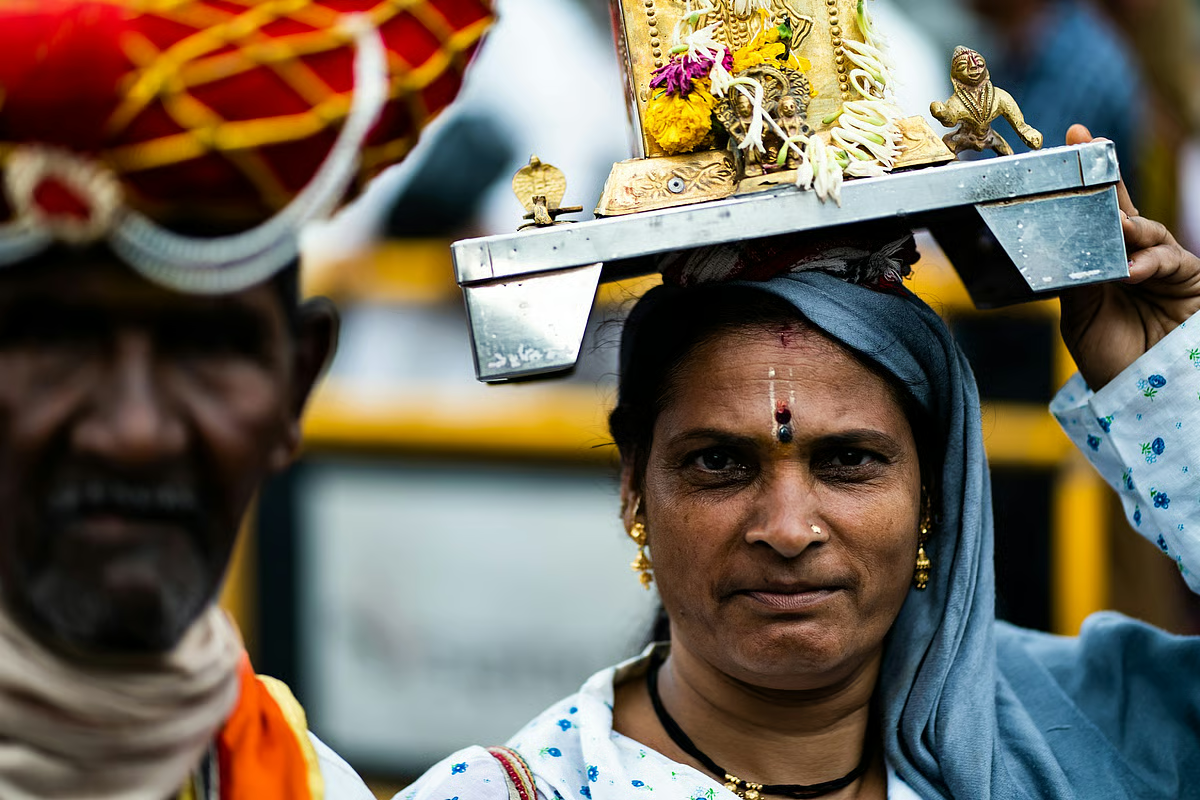
Namit Arora and Romila Thapar on how identities in early and medieval India were formed, contested, and why a shared sense of “Indianness” may be a colonial-era development.
What did it mean to be “Indian” before the modern nation came into being? In this excerpt from Speaking of History: Conversations about India’s Past and Present (Penguin India, Nov 2025), the historian Romila Thapar and the writer and social critic Namit Arora reflect on how identities were formed, imagined and contested in early and medieval India. Ranging across foreign travel accounts, Sanskrit texts, caste hierarchies and colonial transformations, the conversation probes whether any shared sense of Indian identity existed prior to the colonial era, and why the question itself has become so politically charged today. -
Asian Review of Books Podcast about ‘Speaking of History’
In which I speak to Nicholas Gordon, editor of Fortune Magazine and host of the Asian Review of Books podcast, about Speaking of History (audio podcast on ARB site, 38 mins). Nicholas also had me on his show in 2021 to talk about my previous book, Indians.
“What does it mean to be a historian? How do you try to explain the past when sources are lacking? And how do we talk about history when it’s so politicized? In the new book Speaking of History: Conversations about India’s Past and Present (India Allen Lane, 2025), Namit Arora and Romila Thapar discuss some of the challenges facing historians in India today, what it means to be an academic historian, and how ideas around gender, caste and religion may be getting distorted in India’s public history. Namit joins us on the show today… (more)”
-
Why is History So Controversial in Today’s India?
A short conversation about our book-length conversation, Speaking of History. Even at 94, Prof. Romila Thapar is in magnificent form, and Seema Chishti—writer, journalist and editor of the Wire—is brilliant as ever. Give it a watch (55 mins)!
-
What’s Pride-worthy in Hindu India’s past: An Excerpt from ‘Speaking of History’ by Romila Thapar and Namit Arora
Scroll.in has published an excerpt from chapter 21 of Speaking of History, which I’ve reproduced below. I think I’m not a historian but others have their point of view. The excerpt comes from chapter 21, “What’s Pride-Worthy in the Hindu Past?” It follows two previous excerpts in The Wire and The Print. Check ’em all out!

Conversation: Historians Romila Thapar and Namit Arora discuss India’s proudly plural past
NAMIT: In today’s world, most people just luuuuv to take pride in their cultural past. Personally, I find it hard to take pride in things I did not help create—such as the accident of birth into a particular community or territory. That said, I also recognize that if I were inclined to seek pride in such inheritances, I would find plenty in Indian culture to inspire it.
-
An Indian Inferiority Complex: An Excerpt from ‘Speaking of History’ by Romila Thapar and Namit Arora

After the excerpt in The Wire, another excerpt from Speaking of History has now appeared in The Print. IMO, the editors could have included a bit more at the outset to give the selection greater context and a more complete argument—though they were likely constrained by word-length guidelines.
Below, I’m sharing the version I wish they had run, using a less rage-baity title. It’s about 20% longer than their excerpt from chapter 9, and free of ads. I also found their choice of the featured image puzzling but I’ve reproduced it for completeness. Happy reading!
Exploring a Possible Inferiority Complex
NAMIT: Now, it’s true that Hindutva-like religious nationalism also exists in other parts of the world—as in Zionism, Islamism, White Christian nationalism in the USA and Europe, Buddhist nationalism in Sri Lanka and Burma and so on. But despite their many shared features, Hindutva also differs from them. I think some of the differences stem from a deeply internalized cultural inferiority complex among middle-class Hindus, which I’d like to explore here. Scholars such as Ashis Nandy, Christophe Jaffrelot and Partha Chatterjee have explored this complex as partly a consequence of colonialism. I feel it is widespread enough and it helps create a large audience for Hindutva interpretations.
-
Nonviolence and Tolerance in Early India: An Excerpt from ‘Speaking of History’ by Romila Thapar and Namit Arora

Amigos, my newest book—co-authored with Prof. Romila Thapar—is out in the world! On 29 Nov 2025, Speaking of History: Conversations about India’s Past and Present became available worldwide—in print and e-formats—thanks to Penguin India and Three Essays Collective. The book’s official page has the details.
Working on this book since the summer of last year—and getting to know Prof. Thapar—has been a privilege, a joy, and an immensely mind-expanding experience. We discussed numerous aspects of India’s past and present, including many contentious topics, and our occasional disagreements too were illuminating to me. I won’t nudge you to buy a copy … I have full faith. 😊
But if you’d like a taste first, check out this excerpt (from Chapter 16) that has just appeared in The Wire—also reproduced below.
Nonviolence and Tolerance in Early India
“The image of the great king is of one who is a conqueror, and conquest assumes violence and intolerance. So I really don’t buy the theory that early Indians were especially nonviolent or tolerant.” — Thapar, in Speaking of History by Romila Thapar and Namit Arora
-
A talk on Marco Polo’s India of the 13th century
Last month, I was invited to speak about Marco Polo at the sixth annual Indology Festival organized by the Tamil Heritage Trust. The theme this year was “Wanderers and Witnesses: Travellers’ Tales of India” and the festival team had invited various “scholars, authors, and experts to explore how India was perceived, experienced, and recorded by travellers from distant lands through the centuries.”
Twelve talks happened at #THTIndoFest2025 over six evenings, 16–21 June 2025. My talk on Marco Polo (~90 mins, with Q&A) is embedded below but also check out others who spoke at this nice history festival (YouTube Playlist).
-
On Social Scientists Engaging With Civic Spaces
I was part of a panel at the India International Center, Delhi, on 18 Feb, 2025, to discuss a book, Social Scientists in the Civic Space (Routledge, 2025), edited by Arundhati Virmani, Jean Boutier, and Manohar Kumar. To begin with, panelists were invited to offer their views on the book. This is the text of my statement. —Namit Arora

Thank you for inviting me for this discussion. I think the issue of social scientists engaging with civic spaces is a crucial one. The excellent book we’re discussing today examines this engagement through four key dimensions: context, modes of intervention, involvement, and ethical considerations. Its approach is largely historical, offering insights into how scholars have navigated these dimensions in different times and countries.
For instance, in discussing context, the book explores the civic spaces of specific societies at particular times—analyzing their political milieu, education systems, media landscapes, social science institutions, and more. When addressing intervention and involvement, it examines the diverse roles scholars have played—as teachers, policy advisors, public intellectuals, social activists—and how they influenced civic discourse and policy.
-
The Mystic Tradition of India
This is Namit Arora’s foreword to When I See, I Sing: Verses in Translation of Baba Farid, Namdeo, Kabir and Rahim, translated by Pavitra Mohan. First published on Scroll.in.
 Humans have always had a remarkable diversity of religious experiences. Across time and cultures, spiritual practices—whether animistic, mystical, ritualistic, or ascetic—owe much to a common human desire to connect with something greater than oneself. These practices include prayer, fasting, sacrifice, self-mortification, festivals, pilgrimage, meditation, art, music, and dance. Whatever the form, such quests for meaning, transcendence, and connection reflect a universal human impulse.
Among these diverse expressions of spirituality, mysticism is prominent in many world religions, particularly in Hinduism (Bhakti), Islam (Sufism), Judaism (Kabbalah), and Eastern Christianity. It has especially thrived in regions from the Middle East to the Indian subcontinent. Scholar and philosopher Majid Fakhry describes mysticism as rooted ‘in the original matrix of religious experience’—born from an intense awareness of God and the realisation of one’s insignificance without God. This leads the mystic towards a central goal: the dissolution of the ego (fana) and total surrender to God. By shedding their egoistic self and discovering the divine presence within, mystics strive for greater self-realisation. In this transformation, writes Fakhry, ‘man becomes dead unto himself and alive unto God.’
-
“Indian Civilization is an Idea But Also an Enigma”: Karan Thapar interviews Namit Arora
I was honored and delighted to receive an invitation from Karan Thapar himself, one of the sharpest, most incisive, and intellectually astute professional interviewers in India today. He wanted to discuss the web series Indians on his show. But I’m also media-shy, and right after saying yes, I grew anxious about the interview.
Well, I think it turned out alright. 🙂 Thapar asked about 15 questions and skillfully summarized at several places what I’d said in long-winded ways, illustrating once again the basis for his high reputation and numerous awards. See for yourself!
-
Exploring India’s Past: From Al-Beruni to Marco Polo and Ibn-Battuta
I was recently invited to participate in a forum called The Black Hole, an “educational and intellectual space” in Islamabad whose goal is to further science, art, and culture in Pakistan. It is run by Pervez Hoodbhoy, a physicist, author, and secularist known for his vocal and courageous advocacy of scientific temper and progressive values, and who I’ve long admired. He invites authors and thinkers to present and interact with his live audience.
I was delighted by the invitation and overcame my enormous media-shyness to join this event. The session, held on 24 March, began with an introduction by Pervez Hoodbhoy, followed by a screening of Episode 7 of Indians (Alberuni and Marco Polo in India) and a Q&A interaction in Urdu/Hindi/English that lasted over an hour.
-
Our Insatiable Quest for Fire
This is the ninth article in a 12-part series about the Earth-system, how our planet has shaped us as human beings, and how we, in turn, have shaped it The article appeared here first, in Unraveling Climate Change, a series for The Wire.
 Everyone alive today has known only a world of rapidly increasing global material wealth: More goods are more available to more people than ever before. More people are eating more food. More new things are being continuously invented. More people have access to more technology-mediated healthcare, cars, computers and phones. More roads are built, buildings raised, clothes worn, toys and gadgets and appliances used. More people are traveling farther and more often. And the global Gross Domestic Product—possibly the most revered metric in all of human history—has been going up and up and up.
Graphs of consumption or production of various commodities and goods—like sand or cement, steel or cars, houses or furniture, and a host of other things—as well as the size of the human population, emissions of industrial waste, or other metrics reflecting our use of energy and materials, nearly all indicate a strikingly similar growth pattern across time: around the 1950s, all these things began to accelerate. Geologists, anthropologists, and others call this astonishing trend the Great Acceleration. But the Industrial Revolution began two hundred years prior to this. So what was happening in the middle of the 20th Century to fuel such a rush in the consumption of energy and materials, the associated pollution of air, water, and soil, and a dramatic acceleration in the extinction of species and loss of biodiversity?
-
Indians | Ep 10: The Faiths of Varanasi | A Brief History of a Civilization
Varanasi, or Banaras, is among the world’s oldest living cities. Its archaeological finds go back to the 9th century BCE. Emerging in history as Kashi, Varanasi became an early centre of learning. The Buddha preached his first sermon here, which effectively launched Buddhism. The city has an impressive history of religious pluralism and still hosts Brahminical Hinduism, various major and minor faiths and sects of old India, shrines to sundry matas and folk gods, and many flavours of Islam: Shia, Sunni, Sufi, Ahmadiyya. Located on the left bank of the Ganga, it’s the city of Shiva, of seekers and pilgrims, Pirs and Aghoris, death and instant moksha. Muslims form 30% of its people and most of its weaving industry; their Hindu ancestors made Varanasi famous for textiles even in ancient times.
Foreigners like Xuanzang, Alberuni and Bernier left accounts of Varanasi. How do scholars today view religious conversions and temple desecrations in the city under Muslim rulers? In these centuries, popular religion—including Bhakti and Sufism—thrived in Varanasi with locals like Tulsidas, Kabir and Ravidas. It was Tulsidas’s Ramcharitmanas, composed in the 1570s during Akbar’s rule, that turbo-charged Rama’s career as a god in north India. The city then also became a major centre of Indo-Persian culture, co-created by Hindus and Muslims at both elite and commoner levels. I’ll close with a few words on its present.
-
The Agricultural Revolution: An Alternate Telling
This is the eighth article in a 12-part series about the Earth-system, how our planet has shaped us as human beings, and how we, in turn, have shaped it The article appeared here first, in Unraveling Climate Change, a series for The Wire.
 Much as men were likely the primary hunters in foraging societies across the ages, so women were the primary ‘gatherers’ and plant specialists, providing the bulk of the food and medicine. By 21,000 BCE, those of the Levant knew well the produce of their coastal woodlands and neighboring steppelands, which stretched eastward for hundreds of kilometers. At least two common steppe grasses, wheat and barley (jau), produced tasty, nutritionally-dense seeds. Using long, thin, flint blades, they gathered these grasses by the armload. In their small encampments, they threshed out short mounds of seeds and ground these with stones.
Alongside more than a hundred varieties of other plants they gathered nearby, plus meat from hunting, this grain provided an astonishing, almost effortless surplus from their cold, arid landscape. Even with the world in the grip of extreme glaciation, it was enough for their small bands to remain stationary for most of the year—the first multi-seasonal camps we know of, anywhere in the world. But eventually the nomads moved on, leaving behind their heavy mortars to be found and reused in future years, if the grasses grew well.


