The Dilwara Temples

Namit Arora Avatar

Dilwaratemples10Many Indians claim that the Dilwara Jain temples of Mt. Abu are a more magnificient achievement than the Taj Mahal – both were stunningly ambitious, state-sponsored, multi-year, monumental, marble-work projects but the claim is an imponderable to me. One difference, however, springs to mind: while thousands of art lovers and devotees also worked for a generation on each of the two Dilwara temples, the Taj, proof of an emperor’s inability to rationally accept his lover’s death, was built largely by hired men. I can understand a man’s desire for a memorial to his lover; I also believe that a modest memorial need not be any less meaningful, but no, size clearly mattered to Shah Jehan. He had to divert enormous resources of state to fund his absurd private infatuation.


While I think the Taj is rather sublime I am awed by its beauty each time I visit the so-called “romance of its inspiration” bugs me. For the untold thousands who labored on it, Shah Jehan didn’t even have the magnanimity to dedicate the Taj to, say, “all the lovers of Hindustan,” or something similarly inclusive. The poet Sahir Ludhianvi, speaking for the masses, famously said of the Taj: “Ik shahanshah ney daulat ka sahaara ley kar / Ham ghareebon kee mohabbat ka uraaya hai mazaaq”  (An emperor relying so on his wealth / Has ridiculed the loves of the poor like us). On the other hand, the Dilwara temples, built half a millennium before the Taj,  seem to me expressions of a fairly democratic religiosity.


Nakkilake The temples lie a few miles from Mt. Abu, a picturesque hill resort centered on Nakki lake, atop an isolated feature of the Aravali Range in southern Rajasthan. Mt. Abu was once the HQ of the British Rajputana States Agency. If you read Hindi, check out the local rendition at a traffic square of the famous lines from Frost’s Stopping by Woods on a Snowy Evening.


The two main temples at Dilwara, built in the northern Nagara style (as opposed to the southern Dravidian style), are the Vimala Vasahi temple (1031 CE) and Tejpal temple (1200 CE), known for the audacity and the delicacy of their rich marble-work. Unlike most other Indian temples, their exterior is starkly plain; it is the interior that is far more magnificent, especially the breathtaking chandelier-like marble ceilings and ornately carved brackets and pillars. The two temples were commissioned by the Solankis of Gujarat (a branch of the Chalukyas of southern and western India) and one of their former feudatories, the Vaghelas, respectively.


Sadly, photography at this exquisite global cultural heritage site was banned in 1992 for reasons that no one at the temples is willing to articulate clearly (why not allow it for a fee during a designated visiting hour at the least?). Orders, say the orderlies, issue from a managing trust, one that seems to me dominated by conservative and obscurantist Jain elders who, in their infinite and timeless wisdom, also deem it proper to bar menstruating women from entering the temple precincts (enforcing this is fortunately not easy I looked around but saw no sniffer dogs ;-).


Reader Comments


11 responses to “The Dilwara Temples”

  1. Fantastic filigree work in marble in those photos that you posted, Namit. I only remember the poor b&w smudged photo renditions from my history textbooks in school which could never really illustrate the magnificence of the carvings- the words quoting some British historian’s impression were far more impressive and evocative.

  2. “Filigree work” is just the term I was looking for, thank you. Yes, fantastic it is but unfortunately, having seen it up close, I think even these photos don’t do justice to the beauty and the delicacy of the real thing – they were apparently issued by the temple authorities over a decade ago. How I wish I was able to take some myself!

  3. Nice one Namit, as always. It’s interesting you brought up the circumstances in which the Taj was built. My father used to take a very critical view of Shah Jehan’s ego driven art work although he too was properly dazzled by the architectural end product. His was more of a social commentary than Sahir’s silken lines in favor of the less prosperous lovers.
    Those Robert Frost lines were Chacha Nehru’s favorite although he always recited them in English.
    The last part of your comment rang a recent bell and raised a few chuckles. Although I dont’ remember ever in my life being stopped from going to any part of any temple in India (I haven’t been to many), an incident that took place in Houston over the last Christmas break, took me aback.
    A very elaborate and expensive ($7million, said the Houston Chronicle) Swami Narayan(?) temple has been built very near our home. I went there once before during the day time with my sister after its inauguration in 2005. At that time we discovered that if you are wearing a sleevless blouse, they hand you a chadar to wear like a shawl. If you are in shorts, a similar chadar is to be used like a lungi. I didn’t think much of it because both males and females were subject to the same dress code.
    Last month, when my kids were visiting, I went there for the second time with my daughter when the evening arati was going on. Our interest was purely touristic to see the intricate (filigree) work on the marble walls and pillars. But halfway through our amblings we were stopped from going to the front of the temple by a barrier, a vigilant guard and a sign saying firmly, “Only Gents Allowed Beyond This Point.” My daughter found great amusement (and bemusement) at this obstacle and we turned back and left. She asked me why women were not allowed close to the deity. I said, “probably the suspicion of menstruating females and given the lack of sniffing dogs, it is just prudent to stop all women.”

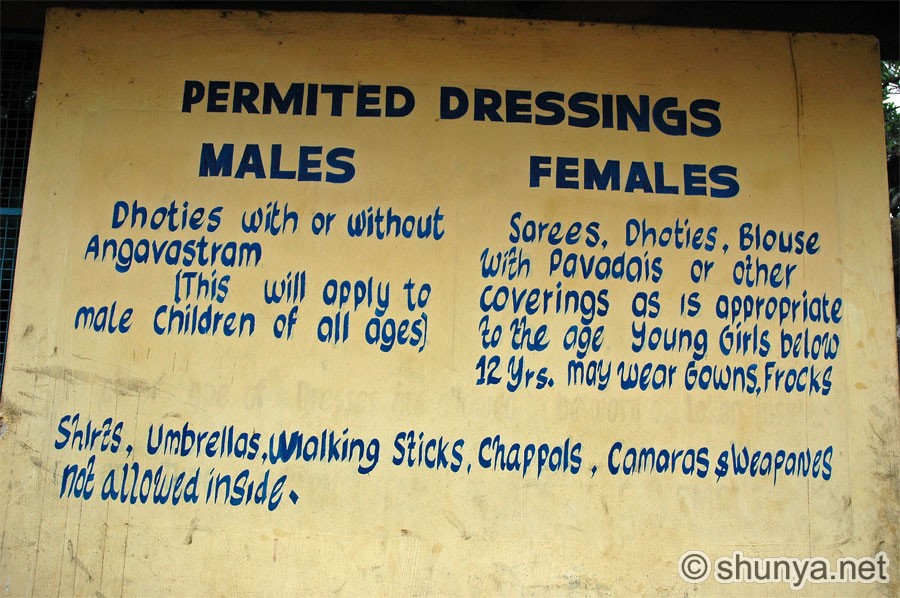
  4. On chadars to be used like lungis, it reminds me of the regulations at a lot of Kerala temples, including the Padmanabhaswamy temple in Thiruvananthapuram ( eek, too hard typing that, I’ll stick to TVM next time!) If you wear any kind of pant or salwar, you are required to wear a chadar/dhoti around the lower half of the body. If you are male, you must take off any shirts ( you are permitted an angavastram, if you wish to retain any top covering.) The reason for covering pants and salwars, I heard, was somewhat related to the perception of Muslims and Britishers as always wearing pants or the like and meant to serve as an additional rule to keep them out- even though a large sign posted says “Only persons professing the Hindu religion are allowed entry”.
    There’s nothing to check about menstruating women, and no religious test applied beyond the ‘appearance’ test- I’ve had Christian friends in college who have been able to enter temples without any fuss.
    Of course, the fuss about women at the famous Sabarimala temple took on a new controversy some months back, with accusations of a Kannada actress having been allowed to visit the shrine despite the prohibition against women between ages 11-50.(I myself didn’t care much for the temple when I went there with my dad at the age of 9. I was too consumed by the misery of walking barefoot on an unhygienic looking path to the temple).

  5. Yes, restrictions on women and non-Hindus exist in too many temples, esp. in south India. It’s interesting (and hard to believe) that this temple in Houston prohibits all women. I too have never run into a temple in India that barred all women from the inner sanctum; it’s typically left to the women to “cooperate” on their own accord.
    As for non-Hindus, since there is no reliable way of identifying them, the rule boils down to foreigners vs. Indians. Not long ago, the “untouchables” were kept out of temples for fear of “pollution”. Foreign tourists are the targets of this discrimination now (though socially the two situations aren’t quite the same). A few temples make foreigners sign a form saying that they respect Hinduism etc., before letting them in.
    A few times on my travels, I protested the rules and insisted on meeting the temple management, always attracting a tamasha-watching crowd in the process. I typically enquired what the reason was for this discrimination, what they were afraid of, etc. Twice, I tried to get foreigners in by reasoning with the authorities. It didn’t work but it raised the cost of continuity, esp. when they got a little sermon from me each time.
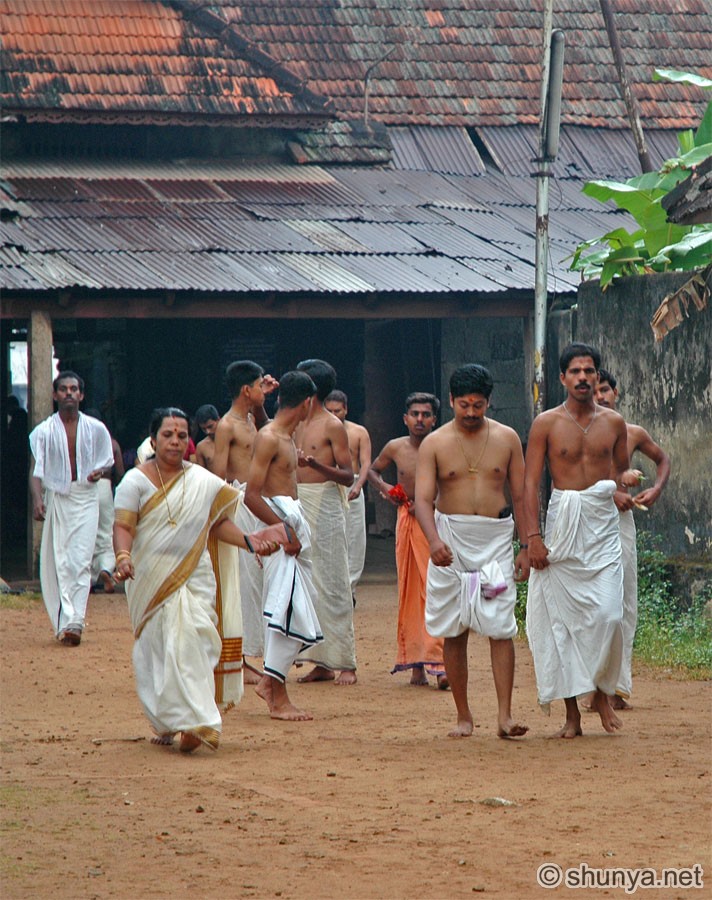
    Here is the dress code of Padmanabhaswamy temple in TVM and some ideal visitors. Given the cost – wearing a dhoti, going topless – I decided to forego the benefits and skip the temple. 🙂 Didn’t have to walk barefoot on unhygenic paths either. Indeed, why are so many Hindus so lax in keeping their places of worship clean (even well endowed temples like Srirangam and Nathdwara)? What god wants to live amid filth?

  6. As for your surprise that it happened in Houston, well don’t be too shocked. I don’t go to the local Durga puja but I have a very good friend who does regularly and feeds me all the gossip. I learnt with some astonishment that some years ago there was some unpleasantness regarding the handling and preparation of the “prasad.” Some people insisted that only Brahmins be allowed the privilege. The matter was quickly resolved when several people threatened to withdraw from the festivities – taking their cheque book with them of course.
    I don’t even think it was the inner sanctum – we were some thirty feet from the deity’s protected niche. The open prayer hall was divided into two, with men sitting in front. The women were all in the back and the two areas were cordoned off from each other accompanied by the ludicrous written notice. At the non- arati time when I had visited with my sister, we were able to go to all parts of the temple.
    The funny thing was that I was a bit more miffed than my feminist daughter. There is a sweet shop on the premises which we had planned to visit. I said that we should give it a miss in protest of the sexist segregation in the prayer hall. My daughter, who loves Indian sweets, shamelessly declared, ” I would love to stand on principle but I really need to eat some laddoos.”

  7. Actually the interiors of the temples are not all that bad in the cleanliness department, though I can see that the dress code would be off-putting. It just happens to be the rule in all Kerala temples and in a couple of TN temples which were in the erstwhile princely state of Travancore.
    I remember my dad persuaded an American dignitary he was showing around the Kanyakumari tourist sector to don the dhoti and angavastram- the temple management didn’t make a huge fuss about the white skin, so long as he was properly attired!
    I suspect that the paths (long trekking routes through the forest etc.) to the Sabarimala temple have since been streamlined quite a bit- it’s no longer the case of ‘stones and thorns under feet’ as the translation of a pilgrim’s chant used to be in earlier years. Though what bothered me at the time was less the ‘stones and thorns’ and more of the spitting that pilgrims would indulge in.

  8. Yes, the Dilwara Jain temples of Mt. Abu are a brilliant piece of history. I visited Mt. Abu, which is also the only hill station in Rajasthan, just a few months back.
    And you have posted wonderful pictures!

  9. Hi, Do you think Taj mahal was built by Shahjahan, then you should read this article Taj Mahal: Was it a Vedic Temple? -The Photographic Evidence
    http://www.stephen-knapp.com/was_the_taj_mahal_a_vedic_temple.htm

  10. Sanjeev,
    That’s a link to some pure, unadulterated bullshit put out by a diarrheal mind. Don’t clutter this thread with more crap please.

  11. There here on earth such lakes and temples
    That tell beauty can be truly divine,
    Transporting one to the region of joy
    They fill a seeker’s heart with Nature’s sun shine
    K.K. Mohanty

Leave a Reply to NamitCancel reply

Contact us:

← Back

Thank you for your response. ✨

Discover more from Shunya's Notes

Subscribe now to keep reading and get access to the full archive.

Continue reading