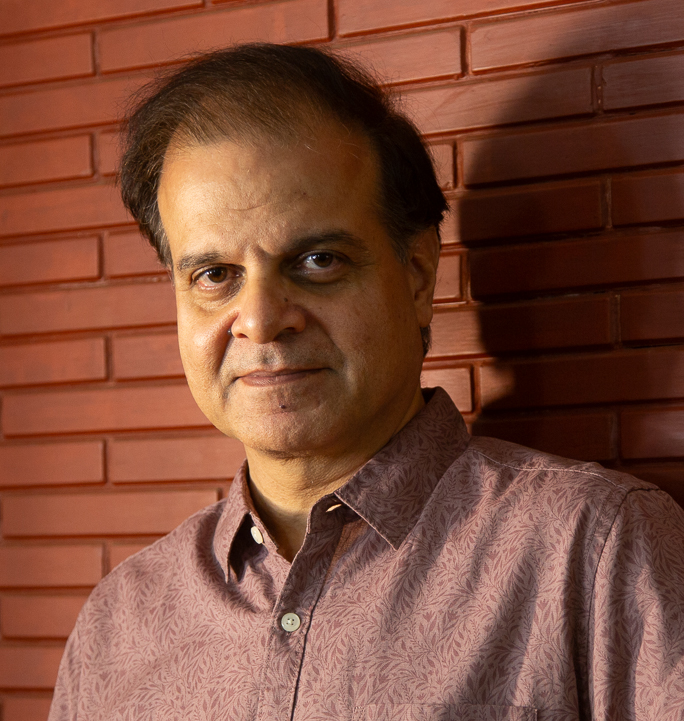
Namit Arora is a writer, humanist, social critic, and travel photographer. He grew up in Gwalior—known for its historic fort, its epigraphic evidence of zero, and Tansen. His proximity to zero—or shunya, zilch, nada—is a great source of pleasure to him. After IIT Kharagpur and a masters in computer engineering from Louisiana, he worked in Silicon Valley for two decades, at both failed startups and big corporations. Whether this made him any wiser is debatable, but it did allow him to take social science courses of dubious practical value at Stanford and to live, work, or travel in scores of countries, with yearlong stints in London and Amsterdam. He quit this profession in 2013 for a life of reading and writing and returned to India. For two years, he volunteered with the Delhi govt. to tackle civic problems; he led the drafting of Delhi’s solar energy policy and a task force on air pollution.
Namit’s writing has appeared in 3 Quarks Daily, The Caravan, The Baffler, The Wire, The Humanist, Philosophy Now, The TLS, The Philosopher, Scroll, Himal, and many anthologies (see his article archive and favorite books). He won the 3QD Arts & Literature Prize in 2011. For two years, 2004–06, he took time off to travel across India and began a photojournal that he has continued to evolve. His photos have been licensed by over 15 museums, 40 academies, and 60 publishers. His videography includes River of Faith, a documentary on the Kumbh Mela. He taught at the Adianta School for Leadership & Innovation, and spoke at Nirmukta Thinkfest 2015 and TEDx Gurugram 2016.

Namit has authored four books: (1) Speaking of History: Conversation about Indian’s Past and Present (with Romila Thapar), (2) Indians: A Brief History of a Civilization, (3) The Lottery of Birth: On Inherited Social Inequalities, and (4) the novel A California Story (US) / Love and Loathing in Silicon Valley (India). In 2024, he wrote and anchored Indians, a history web series in ten episodes. He is on Twitter, Facebook, YouTube, and Email.
Recent Posts from Author
-
Teotihuacan, Mexico City
In early first century CE, Teotihuacan was just a hamlet. Its population then grew as people from the Valley of Mexico began arriving there. With a larger labor force at its disposal, the local rulers grew richer and devised a master plan for a new city with the great building projects of the pyramids of the sun and the moon. The plan was inspired by the Aztec conception of the universe, and indeed, as the place where the universe itself originated. It also made Teotihuacan the grandest city in Mesoamerica during the Classic Period.
 Teotihuacan’s control of the obsidian mines at Otumba and Pachuca allowed it to centralize the production of obsidian goods, some for domestic sale, the rest for export. With this, and its monopoly on the distribution of Thin Orange pottery, Teotihuacan developed a trading system that embraced almost every region of Mesoamerica, including places as far away as the Maya area, the modern state of Guerrero, and the area around the Gulf of Mexico.
  Teotihuacan’s metropolitan feel, its trading system, and the religious prestige it accrued from its giant pyramids and related ceremonies, attracted a floating population that enriched the quality of life in the great city. At its peak between 150—450 CE, it stretched over 30 square km and had a population of between 150,000 and 250,000.
 -
Halloween in the Castro
-
Wolfe on Porn
A thought-provoking article by Naomi Wolfe on the impact of porn on men and women:
 At a benefit the other night, I saw Andrea Dworkin, the anti-porn activist most famous in the eighties for her conviction that opening the floodgates of pornography would lead men to see real women in sexually debased ways. If we did not limit pornography, she argued—before Internet technology made that prospect a technical impossibility—most men would come to objectify women as they objectified porn stars, and treat them accordingly. In a kind of domino theory, she predicted, rape and other kinds of sexual mayhem would surely follow.
The feminist warrior looked gentle and almost frail. The world she had, Cassandra-like, warned us about so passionately was truly here: Porn is, as David Amsden says, the “wallpaper” of our lives now. So was she right or wrong?
Category: Culture -
Beyond Hope and Change
Two eager contestants, tooting their horns and dissing each other. The media readying us for fireworks, sharp attacks, a “do or die” fight. Showdown in Texas is how CNN bills the live event. No, not a big boxing night, only the 19th Democratic Primary debate in Austin. Held in a giant auditorium, the event is less debate, more performance and spectacle, with snappy phrases, choreographed delivery, calculated show of charm and emotion. With millions watching and thousands cheering lustily, what matters above all is the air of authority and confidence—in voice, body language, rhetorical flourishes. The people want theatrics, verbal sparring, sticky moments. People-meters report audience sentiment in real-time. Smooth, photogenic pundits wait in the wings to offer post-debate punditry. Welcome to democracy in America.
 It is no small miracle when—despite all the dubious qualities required to survive the endurance test that the primaries have become—a worthy candidate still emerges. This time, Obama holds that promise. He seems to me more decent than others and exudes a more nuanced, reflective, and principled approach to issues, though his platitudes and populism worry me (“yes we can”, “turn the page”, opposing Nafta, promising lavish economic stimulus packages). He’ll likely be less jingoistic and less ideological than others. I’m encouraged by his years in Indonesia, which surely help him see an equal humanity in non-Americans (as should his father’s Kenyan and Muslim heritage). This is hugely positive, if you pause to think about it.
But while Obama may be a fine person, will he focus on the right things and deliver results? Unless he does, he’ll not make a fine president. Beyond all the voluptuous talk on hope and change, here is my list of the “right things” I want the next American president to focus on:
Category: Politics -
Coetzee on Marquez
Coetzee reviews Marquez’s Memories of My Melancholy Whores:
 Gabriel García Márquez’s novel Love in the Time of Cholera ends with Florentino Ariza, at last united with the woman he has loved from afar all his life, cruising up and down the Magdalena River in a steamboat flying the yellow flag of cholera. The couple are seventy-six and seventy-two, respectively.
In order to give unfettered attention to his beloved Fermina, Florentino has had to break off his current affair, a liaison with a fourteen-year-old ward of his, whom he has initiated into the mysteries of sex during Sunday-afternoon trysts in his bachelor apartment (she proves a quick learner). He gives her the brushoff over a sundae in an ice cream parlor. Bewildered and in despair, the girl commits unobtrusive suicide, taking her secret with her to the grave. Florentino sheds a private tear and feels intermittent pangs of grief over her loss, but that is all.
Category: Books & Authors -
Gandhi After Gandhi
An amusing, insightful essay on the legacy of MK Gandhi by the noted sociologist Ashis Nandy:

There are four Gandhis who have survived Mohandas Karamchand Gandhi’s death. Fifty years after Gandhi’s (1861-1948) assassination, it may be useful to establish their identities, as the British police might have done in the high noon of colonialism. All the four Gandhis are troublesome, but they trouble different people for different reasons and in different ways. They are also useable in contemporary public life in four distinct ways. I say this not in sorrow, but in admiration. For the ability to disturb people — or, for that matter, be useable — one hundred and thirty years after one’s birth and fifty years after one’s death is no mean achievement. Frankly, I do not care who the real Gandhi was or is. Let academics debate that momentous issue. Contemporary politics is not about ‘truths’ of history; it is about remembered pasts and the problems of fashioning a future based on collective memories. For better or for worse, Gandhi seems to have entered that memory. -
Reza Aslan on Religion
Continuing my quest to highlight significant viewpoints on important topics, here is an Apr 2007 debate worth watching between Reza Aslan and Sam Harris. Topics include religion, Islam, terrorism, etc. Harris did little to change my view of him; Aslan is the one to watch.
-
How Terrorism Works
Experts on Islamic terrorism are now everywhere, spouting wisdom on countless media outlets and blogs. Most of them—including scholars, novelists, scientists—reflexively summon their gut to explain what turns Muslims into terrorists, marshaling anecdotes and selective data as evidence. The Qur’an is the underlying cause to some, sociopolitical inequities to others; virgins in paradise explain much to some, follies of US foreign policy to others; hatred of “freedom-loving” West suffices for some, dislocations of modernity to others. Rare is the attempt to understand terrorists themselves as social and moral beings (as, for instance, in the movie Paradise Now).
 An insightful analyst of modern terrorism is Scott Atran (see my previous post on Sacred Conflicts). He has done pioneering field research on suicide bombers and the social dynamics of terrorist networks. Watch this remarkable lecture he gave at the Beyond Belief conference in Nov 2007 (attached below). The same material is summarized in this slideshow for the US State Department (I’m surprised they invited him and wonder how he was received). Here are ten conclusions I’ve selected from it:
 - Global Al-Qaeda is now a viral, social movement and political ideology, not a well organized operation with command and control. Young men self-radicalize in their social groups as soccer and camp buddies, neighbors and schoolmates, etc.
- The new wave of terrorism is about “youth culture”, not the Koran. It cannot be checked by military means or elders spouting niceties from the Koran, but with ideas and proposals for action that address their sense of injustice and moral outrage.
- Prison radicalization in the USA vs. Europe differs significantly: Foreign-born Muslims, like Jews, are underrepresented in US prisons. But Muslims in European prisons are wildly over-represented (for many of the same reasons that Blacks in US prisons are over-represented). Nevertheless, prior religious education is a negative predictor of radicalization.
- Global Al-Qaeda is now a viral, social movement and political ideology, not a well organized operation with command and control. Young men self-radicalize in their social groups as soccer and camp buddies, neighbors and schoolmates, etc.
-
Globalization
Shahnaz Hussain, Fox News, reporting in her British accent on Amsterdam inspired Sexpo in Mexico City (click for video).

-
On Imre Kertesz
Years ago when I read Fateless—a Holocaust novel by Imre Kertesz—I was floored by its brilliance. “Kertesz’s spare, understated prose and the almost ironic perspective of Gyorgy Köves, limited both by his youth and his inability to perceive the enormity of what he is caught up in, give the novel an intensity that [makes] it difficult to forget.” Kertesz won the Nobel Prize in 2002 (read his acceptance lecture) “for writing that upholds the fragile experience of the individual against the barbaric arbitrariness of history”:
 In his writing Imre Kertész explores the possibility of continuing to live and think as an individual in an era in which the subjection of human beings to social forces has become increasingly complete. His works return unremittingly to the decisive event in his life: the period spent in Auschwitz, to which he was taken as a teenage boy during the Nazi persecution of Hungary’s Jews. For him Auschwitz is not an exceptional occurrence that like an alien body subsists outside the normal history of Western Europe. It is the ultimate truth about human degradation in modern existence.
Kertész’s first novel, Sorstalanság, 1975 (Fateless, 1992), deals with the young Köves, who is arrested and taken to a concentration camp but conforms and survives. The novel uses the alienating device of taking the reality of the camp completely for granted, an everyday existence like any other, admittedly with conditions that are thankless, but not without moments of happiness. Köves regards events like a child without completely understanding them and without finding them unnatural or disquieting – he lacks our ready-made answers. The shocking credibility of the description derives perhaps from this very absence of any element of the moral indignation or metaphysical protest that the subject cries out for. The reader is confronted not only with the cruelty of atrocities but just as much with the thoughtlessness that characterised their execution. Both perpetrators and victims were preoccupied with insistent practical problems, the major questions did not exist. Kertész’s message is that to live is to conform. The capacity of the captives to come to terms with Auschwitz is one outcome of the same principle that finds expression in everyday human coexistence.
Category: Books & Authors -
The Last Empire
August afternoons in Shanghai, ambling down Nanjing Road with posh boutiques blasting chilled air through open doors into the sultry street, one might imagine that energy is free in China. At less than 5c per KWH, it is certainly cheap (10c in India and the US). But the real costs are hidden, though, increasingly, not very well. Most visitors to China are struck by its urban air pollution. A pall of sulphrous smoke hangs over towns and cities and even wafts through the countryside into neighboring countries. One new coal-fired power plant opens each week. Respiratory illnesses are common. In 2006, China surpassed the US to become the leading producer of green house emissions in the world.
This is not breaking news. Much has been written about China’s environmental crisis in recent years: vanishing forests, encroaching desert, depleting ground water, acid rain, toxic chemicals in polluted rivers, etc. China has clearly prioritized economic growth over environmental health. But a part of the problem is inherent in the drivers of its economic growth — China has become the industrial heartland of the world. The developed countries have, in effect, shifted their factories and pollution to China (this is one outsourcing no politician in the US complains about). As a result, as consumers, all of us are now a party to China’s environmental crisis. Each time we buy a plastic toy, a blender, or an iPod, we send a puff of sulphrous smoke into China’s air. And some of it is coming back to haunt us in our own backyards!
A decent survey of China’s environmental malaise by Jacques Leslie recently appeared in Mother Jones:
-
Pinker, the Storyteller
 Many evolutionary psychologists, including Steven Pinker, professor at Harvard, claim that our minds at birth are not a blank slate, and further, that evolution has endowed humans with a “moral instinct”. In other words, we have evolved an instinct to act often from motives beyond narrow self-interest, and to make value judgments like right/wrong, just/unjust, etc.
 This seems reasonable to me. We appear to be a complex mix of nature and nurture. But what is the relationship between our evolutionary programming and our everyday morality? Can a science of the moral instinct explain human morality? Or does the realm of culture and experience muddy up the waters too much?
First of all, it is worth noting that the moral instinct, like other instincts, is only a driving force; it is amoral by itself—just as our instinct for power is distinct from an act of power, instinct for storytelling distinct from stories, instinct for sex distinct from a sexual act. Morality comes into play when value is assigned to an act or idea, for e.g., robbing a rich landlord and calling it just, or declaring torture wrong. Our moral instinct, quite unbidden, simply drives us to weigh the impact of an act on others and assign to it a value. (Anthropological data suggests that, in addition to this moral instinct, certain aspects of our morality, i.e., the value we assign to an act, may also be universal and could be innate.)
-
The Silence of the Night
Here is an excerpt from a speech delivered by Dr. Martin Luther King, Jr. on 4 April 1967 at a meeting of Clergy and Laity Concerned at Riverside Church in NY City. He was killed exactly a year later when he was only 39. This is how one Christian preacher bravely spoke out against the Vietnam war. A tad different, shall we say, from the Rapture-ready evangelical preachers of today.

… Even when pressed by the demands of inner truth, men do not easily assume the task of opposing their government’s policy, especially in time of war. Nor does the human spirit move without great difficulty against all the apathy of conformist thought within one’s own bosom and in the surrounding world. Moreover when the issues at hand seem as perplexed as they often do in the case of this dreadful conflict we are always on the verge of being mesmerized by uncertainty; but we must move on.
Some of us who have already begun to break the silence of the night have found that the calling to speak is often a vocation of agony, but we must speak. We must speak with all the humility that is appropriate to our limited vision, but we must speak. And we must rejoice as well, for surely this is the first time in our nation’s history that a significant number of its religious leaders have chosen to move beyond the prophesying of smooth patriotism to the high grounds of a firm dissent based upon the mandates of conscience and the reading of history. Perhaps a new spirit is rising among us. If it is, let us trace its movement well and pray that our own inner being may be sensitive to its guidance, for we are deeply in need of a new way beyond the darkness that seems so close around us.
…
And as I ponder the madness of Vietnam and search within myself for ways to understand and respond to compassion my mind goes constantly to the people of that peninsula. I speak now not of the soldiers of each side, not of the junta in Saigon, but simply of the people who have been living under the curse of war for almost three continuous decades now. I think of them too because it is clear to me that there will be no meaningful solution there until some attempt is made to know them and hear their broken cries. -
How Fiction Works
 Good critics, seems to me, are as rare as good artists, and for some reason their skills rarely coincide in a single person. At the very least, a good critic situates the work in a larger context and challenges us to read more closely and to demand more from art. One critic I have profitably read for years is James Wood, via his essays on Hamsun, Martel, Updike, Zadie Smith, Coetzee, and others. The aesthetic qualities he values in literary art include psychological realism with “characters who’ve been let off the leash by their creator, and for whom the largest metaphysical questions are in play.” In addition,
 Wood is noted for coining the genre term hysterical realism, which he uses to denote the contemporary conception of the “big, ambitious novel” that pursues vitality “at all costs.” Hysterical realism describes novels that are characterized by chronic length, manic characters, frenzied action, and frequent digressions on topics secondary to the story.
Wood has ripped into lots of famous writers: Updike, DeLillo, Rushdie, Franzen, Pynchon, Toni Morrison, etc. — rippings I largely agree with. The writers he admires include Bellow, Chekhov, Lawrence, Woolf, and Naipaul. In his disdain for postmodern trends, he has been accused of betraying an evangelical zeal at times (he agrees). Notably, I found his own first and only novel, The Book Against God, rather unremarkable for its character and conflict, which a critic as demanding as Wood himself would have taken to task for its humdrum vision. His gifts are more evident in his two books of essays, to which he has just added a third one, How Fiction Works. Here is a rave review:
-
Noble or Savage?
After 50,000 years of human “progress”, some cautiously optimistic thoughts on our future:
 Human beings have spent most of their time on the planet as hunter-gatherers. From at least 85,000 years ago to the birth of agriculture around 73,000 years later, they combined hunted meat with gathered veg. Some people, such as those on North Sentinel Island in the Andaman Sea, still do. The Sentinelese are the only hunter-gatherers who still resist contact with the outside world. Fine-looking specimens—strong, slim, fit, black and stark naked except for a small plant-fibre belt round the waist—they are the very model of the noble savage. Genetics suggests that indigenous Andaman islanders have been isolated since the very first expansion out of Africa more than 60,000 years ago.
About 12,000 years ago people embarked on an experiment called agriculture and some say that they, and their planet, have never recovered. Farming brought a population explosion, protein and vitamin deficiency, new diseases and deforestation. Human height actually shrank by nearly six inches after the first adoption of crops in the Near East. So was agriculture “the worst mistake in the history of the human race”, as Jared Diamond, evolutionary biologist and professor of geography at the University of California, Los Angeles, once called it?
Category: History -
The Relevance of JS Mill
John Stuart Mill, the great liberal thinker of 19th century Britain, is best known for his influential discourses on liberty and utilitarianism. But how relevant is he to our own age? David Marquand opines in the New Statesman.
 There is no doubt that Mill was on the right (in other words, left) side in most of the great political battles of his time … Social democrats of our day have much to learn from some of his less familiar writings. His long review of Alexis de Tocqueville’s Democracy in America, in which he insisted that strong local democracy was a precondition for democracy at the national level and emphasised the need for a diverse civil society, rich in what would now be called “social capital”, resonates as powerfully today as it did when he wrote it. His insight that democratic citizenship is a practice, which has to be learned through strenuous activity in small groups, not a chocolate bar to be handed down from on high by a benevolent state, was widely shared in the early labour movement …
But this, too, is irrelevant to Mill’s claim to iconic status. “On Liberty” is the foundation stone of that claim; and despite its captivating panache and emotional force, I can’t suppress nagging doubts about its value for the 21st century.
-
The Dying of Susan Sontag
David Rieff, the only child of Susan Sontag (essayist, novelist, filmmaker, and activist — a rather overrated thinker in my estimate), has written a book on his mother’s last days, Swimming in a Sea of Death: A Son’s Memoir. Here is a review by Mark Greif:
 Western thought records a long tradition of morbid interest in how philosophers met their deaths. Memorials, testimonies, and whole Platonic dialogues have been devoted to great thinkers’ final hours. That’s because, historically, the ability to face mortality with perfect equanimity, and fearlessly hold onto values higher than those of daily life, was considered the greatest part of wisdom. “And is not philosophy a practice of death?” Socrates asked in the Phaedo. It was, of course, a rhetorical question: Socrates drank his hemlock, calmed his disciples, and earned the amazement of posterity — his death demonstrating how great a philosopher he was. Epicurus, who famously preached the doctrine that death must hold no fear because no person persists past death to suffer from it, proved his consistency by dying happily, drinking wine in a warm bath.
In modern times, too, philosophers’ deaths have had great significance — like that of David Hume, a notorious atheist. Christians across Europe prayed that he would be terrified into a deathbed conversion or betray some tiny hope for immortality. After visiting him in his final hours, however, the famous biographer James Boswell testified that Hume remained wholly consistent to the end, jolly and godless to his last breaths.
-
Teacher and Apprentice
A fascinating, behind-the-scenes look at the minds and machinations of two political animals:
 A few weeks after he was elected to the U.S. Senate, Barack Obama told his staff he wanted to meet with Hillary Clinton. In her years as a senator, Clinton had deftly navigated many of the challenges that now confronted Obama. She had come to the Senate as a national figure whose celebrity eclipsed (and therefore imperiled) her status as a freshman senator. She had a broad but shallow base of support among the voters she represented. And she, like Obama, held national political ambitions that depended heavily on how well she performed in the Senate.
On February 1, 2005, the two talked for an hour in Clinton’s cheerful, canary-yellow Senate office. Obama developed a good sense of the Clinton algorithm for success: Don’t be a showboat. Keep your head down. Choose the right committees, the ones that will allow you to deliver tangible benefits to your state. Go to hearings, stay the whole time, wait to speak, follow the lead of the chair or the ranking member, and remain quiet and humble at press conferences.
Category: Politics