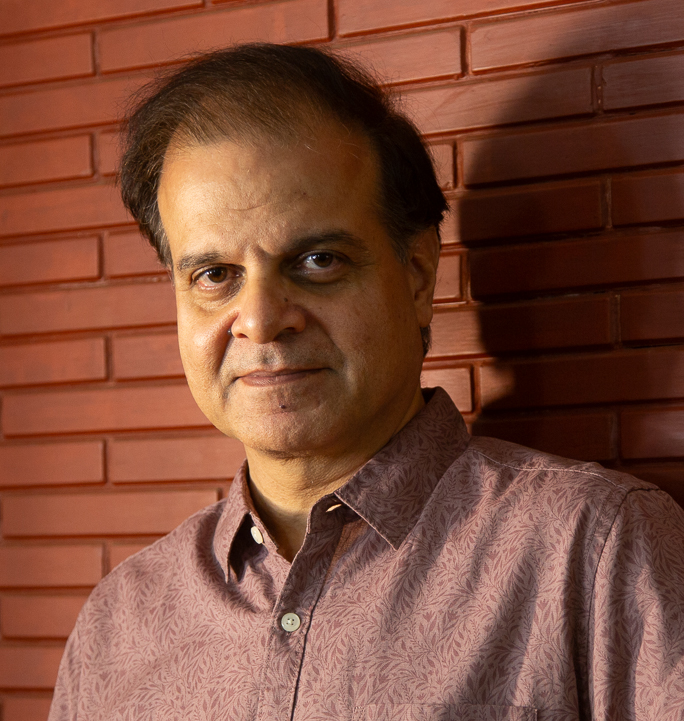
Namit Arora is a writer, humanist, social critic, and travel photographer. He grew up in Gwalior—known for its historic fort, its epigraphic evidence of zero, and Tansen. His proximity to zero—or shunya, zilch, nada—is a great source of pleasure to him. After IIT Kharagpur and a masters in computer engineering from Louisiana, he worked in Silicon Valley for two decades, at both failed startups and big corporations. Whether this made him any wiser is debatable, but it did allow him to take social science courses of dubious practical value at Stanford and to live, work, or travel in scores of countries, with yearlong stints in London and Amsterdam. He quit this profession in 2013 for a life of reading and writing and returned to India. For two years, he volunteered with the Delhi govt. to tackle civic problems; he led the drafting of Delhi’s solar energy policy and a task force on air pollution.
Namit’s writing has appeared in 3 Quarks Daily, The Caravan, The Baffler, The Wire, The Humanist, Philosophy Now, The TLS, The Philosopher, Scroll, Himal, and many anthologies (see his article archive and favorite books). He won the 3QD Arts & Literature Prize in 2011. For two years, 2004–06, he took time off to travel across India and began a photojournal that he has continued to evolve. His photos have been licensed by over 15 museums, 40 academies, and 60 publishers. His videography includes River of Faith, a documentary on the Kumbh Mela. He taught at the Adianta School for Leadership & Innovation, and spoke at Nirmukta Thinkfest 2015 and TEDx Gurugram 2016.

Namit has authored four books: (1) Speaking of History: Conversation about Indian’s Past and Present (with Romila Thapar), (2) Indians: A Brief History of a Civilization, (3) The Lottery of Birth: On Inherited Social Inequalities, and (4) the novel A California Story (US) / Love and Loathing in Silicon Valley (India). In 2024, he wrote and anchored Indians, a history web series in ten episodes. He is on Twitter, Facebook, YouTube, and Email.
Recent Posts from Author
-
On Herotodus’ Histories
By Namit Arora
 “This, however, I know—that if every nation were to bring all its evil deeds to a given place in order to make an exchange with some other nation, when they had all looked carefully at their neighbors’ faults, they would truly be glad to carry their own back again.” — Herodotus in Histories.
 -
War and the American Republic
(Cross-posted on 3 Quarks Daily, where it has received many comments.)
 Shortly before the appalling ‘Shock and Awe’
attack on Iraq, and for years after, public support for the war was
high in the U.S.[1] It was evident in the high approval ratings for Bush,
who had hoped that the war would turn him into a great president and
American hero. As if taking a cue from the Senate, the mainstream media
mostly stood united. Few even from the universities came out to protest. A great many Americans silently relished their mounting excitement. -
Marketing the Military
Check out these military recruitment ads from around the world: Russia, Taiwan, Ukraine, Estonia, Japan, Sweden, France, Australia, England, Lebanon, Singpore, and the US. They pack in so many clues to national character and the state of society.
Consider, for instance, the ad below from India, where recruits largely come from the lower middle class — from, say, the 40% of the population beneath the top 20%. In a society riven by class, how does the Indian military market itself? — as a ticket to a higher class, where people follow “the best traditions”, strive to “be the best”, dress smartly, speak Hinglish, attend garden parties, sail, play golf, ride horses, and frequent swimming pools. Indeed, borrowing a page from Bollywood fantasies, it almost makes the military seem like an exciting vacation package! Be sure to check out the other ads, no less fascinating! (Via Leanne Ogasawara)
-
You Think, Therefore, You Can
Neurobiology tells us that when we think or feel, a host of neurons in our brains fire electrical signals. It turns out that certain thoughts—like wishing an object to move spatially—and certain emotions, have electrical signatures that can be identified by external sensors attached to our heads. This discovery is not new. What is new is an inexpensive headset from Emotiv Systems that can “read our minds” and issue commands to machines. Check out the video below and ponder both the positive and negative possibilities of this technology.
-
Confucius and Modern China
An interesting article on China’s emerging political culture by Daniel A. Bell, professor of ethics and political philosophy at Tsinghua University, Beijing. A communitarian at heart, he has written perceptively about the so-called Asian values and against the universal pretensions of western liberalism. He is also the author of China’s New Confucianism: Politics and Everyday Life in a Changing Society.

-
Bollywood’s India
 Here is a lecture on Bollywood by Rachel Dwyer, Prof of Indian Cultures and Cinema at the University of London (Nov 09). You may find it worth watching for its sociological insights, or even just to learn what a leading scholar of Bollywood now says about “Hindi cinema as a guide to modern India” in under an hour (rest is Q&A). For South Asians, a bonus might be the many nostalgia-inducing clips from old Hindi movies. (Bollywood scholarship is apparently hot, says this article.)
 -
The Life and Times of Evert Cilliers
Here is an excellent piece by one of my co-authors at 3QD, Evert Cilliers: ‘The World Cup, My White Africaner Skin, My Fascist Parents, Mandela, Obama, and Forgiveness’. Evert grew up in South Africa, left some decades ago, and now lives in the US. I learned a good deal about South Africa from his personal journey and from the everyday human details he relates. I particularly liked his take on the life he had in the upper crust of white society, his relationships, and various episodes from his past. His writing has a couple of things that are rather rare: honesty and heart. The piece is long for a blog post but definitely worth it.

Five weeks ago I said to my brilliant girlfriend: “I’d like to see my father before he dies.” She said: “Congratulations.” She’d been asking me on and off for two years whether I’d like to go and visit him where he lives in Cape Town, South Africa, and my stock answer had always been: “I don’t have the slightest interest in ever seeing my father again.”
Category: Books & Authors -
On Caste Privilege
(Cross-posted on 3 Quarks Daily, where it has received many comments.)
 An early goal of British imperialists in India was to create a class of local elites in their own image. They would be, wrote Thomas Macaulay, ‘interpreters between us and the millions whom we govern; a class of persons Indian in blood and colour, but English in tastes, in opinions, in morals and in intellect.’ An elite class did emerge, not surprisingly from the socially dominant upper-caste Hindus of urban India.
As early as 1873, the social reformer Jotirao Phule had criticized the early colonial model of ‘high class education’ for creating a ‘virtual monopoly of all higher offices … by the Brahmins.’[1] These elites, chin-deep in caste identities, saw themselves as innately superior to other Indians, mirroring the class- and race-based prejudices of the British. No wonder they got along so well. In fact, European Orientalists, armed with new theories about the origins of Sanskrit and the influx of light-skinned people into the Subcontinent, saw these caste elites as their long separated Aryan brethren. The latter, only too glad with this association, soon emerged as native informants and collaborators in interpreting ‘Indian’ society and culture, and in shaping a historiography that selectively glorified its past and framed it as largely ‘tolerant’, ‘spiritual’, and ‘nonviolent’, except when rudely disrupted by Muslim invaders.
-
On Power, Human Nature, Justice
I saw this 1971 exchange between Chomsky and Foucault some years ago (I especially resonate with the latter’s take on these topics). Part 1 is below, here is Part 2. I wish the entire exchange was available online but it’s not—here is a transcript (thanks, Louise).
-
How Facts Backfire
 Joe Keohane on “a surprising threat to democracy: our brains”:
It’s one of the great assumptions underlying modern democracy that an informed citizenry is preferable to an uninformed one. “Whenever the people are well-informed, they can be trusted with their own government,” Thomas Jefferson wrote in 1789. This notion, carried down through the years, underlies everything from humble political pamphlets to presidential debates to the very notion of a free press. Mankind may be crooked timber, as Kant put it, uniquely susceptible to ignorance and misinformation, but it’s an article of faith that knowledge is the best remedy. If people are furnished with the facts, they will be clearer thinkers and better citizens. If they are ignorant, facts will enlighten them. If they are mistaken, facts will set them straight.
-
Blocked by Caste
 Is urbanization and industrial development defeating
the inequities of caste in India, as many upper-caste Indians like to believe (using it to buttress their opposition to caste-based reservations)? Well, not quite.Cities do offer greater anonymity and a diversity of jobs unrelated to
traditional caste occupations, thereby weakening many, perhaps even the worst, forms of rural
casteism. An office-going Brahmin
is unlikely to worry about being polluted if he brushes against a Dalit in a crowded bus, or object to eating out lest a Dalit prepared the meal. But
even as many old caste abuses have vanished or weakened in the face of
urbanization, others have arisen or evolved into malignant forms. Industrialization is indeed a turbulent force for the caste system,
but it is not in itself a socially progressive force. Depending on the
injustice and inequities already present, capital and industry can deepen preexisting social privileges and discrimination, which seems to be the
case in India.As many historians of caste have noted, caste in the urban milieu has morphed to
behave more like an ethnic community, whose members not only harbor
notions of “ethnic” distinctiveness but also a strong consciousness of
rank vs. other caste communities. This continuing lack of egalitarianism then
poisons urban civic life. It impacts hiring decisions; access to rental
housing, health care, and public services; response from law
enforcement; judicial verdicts; etc. In our age of economic
liberalization, even the Indian private sector oozes discrimination from all its pores. If this is a surprise, a
recent and extensive study, Blocked by Caste, should decisively dispel the
belief that the private sector is mostly caste-blind and hires based on
‘merit’. It shows that equally qualified Dalit and Muslim résumés are much less likely
to get picked than upper-caste ones, and exposes other “hidden nuances of caste prejudice in the language of globalisation that
contemporary India speaks.” -
The Discreet Charm of the Chimpanzee
Here are three interesting articles on the social life of chimpanzees,
on how they learn, fight, and console.Prestige Affects Cultural Learning in Chimpanzees

-
The Lost Art of Democratic Debate
The inimitable Michael Sandel’s TED talk, a short digest of his brilliant Harvard course that I heartily recommend for one and all.
-
Putty in Her Hands
(An excerpt from a longer work of fiction. Cross-posted on 3 Quarks Daily)
 Sasha calls on Saturday afternoon, ‘Are you free?’
 Sasha is a Russian escort, 28, slim, dark-haired, with dreamy green eyes. She needs a ride in an hour to Plaza Hotel, downtown. After a three-day break, she accepted a two-hour job today, but her car will not start. ‘I’ll make up to you,’ she tells Ved suggestively.
Category: Fiction & Poetry -
The Battle for Niyamgiri
 The “Avatar style” battle between the big bad British corporation Vedanta Resources and Dongria Kondh, an endangered Primitive Tribal Group in Orissa, India, has attracted the attention of Bianca Jagger.
For generations, the Kondh of Orissa, in India, have lived on a fertile mountain which they revere as a god. But since the arrival in 2008 of a British aluminium refinery, their land has been poisoned and the villagers imprisoned. Now, the tribes people are making what could be their last stand.
Also check out this interesting video story on the Kondh’s plight that I found on Survival International.
-
Gloom Boom & Doom
Marc Faber is the pessimist’s economist, a “contrarian” who has been frequently right, and publisher of the investment newsletter “The Gloom Boom & Doom Report”. His website is even adorned by the Dance of Death paintings by Kaspar Meglinger. In this wide-ranging lecture, Faber analyzes the recent past and the future of global economics (1 hr, 8 mins). If you prefer a bullet-point summary, here is a decent one.
-
Deresiewicz on Education
A really good essay by William Deresiewicz on what it means to be educated, and the many downsides of attending elite universities. It also made me think of my own
gripe four years ago against my alma mater, IIT Kharagpur. 🙂
… if you’re afraid to fail, you’re afraid to take risks, which begins to explain the final and most damning disadvantage of an elite education: that it is profoundly anti-intellectual. This will seem counterintuitive. Aren’t kids at elite schools the smartest ones around, at least in the narrow academic sense? Don’t they work harder than anyone else—indeed, harder than any previous generation? They are. They do. But being an intellectual is not the same as being smart. Being an intellectual means more than doing your homework.
-
Collateral Murder
I came across this harrowing footage
from 2007 of a US Apache helicopter attack in which two Reuters employees, Saeed Chmagh and Namir Noor-Eldeen, as well as nine others get hunted down like animals in a Baghdad public square. Then it gets worse. It was leaked in April this year by Bradley Manning, a 22-year old Army Intelligence analyst, who was just found out and is now behind bars.