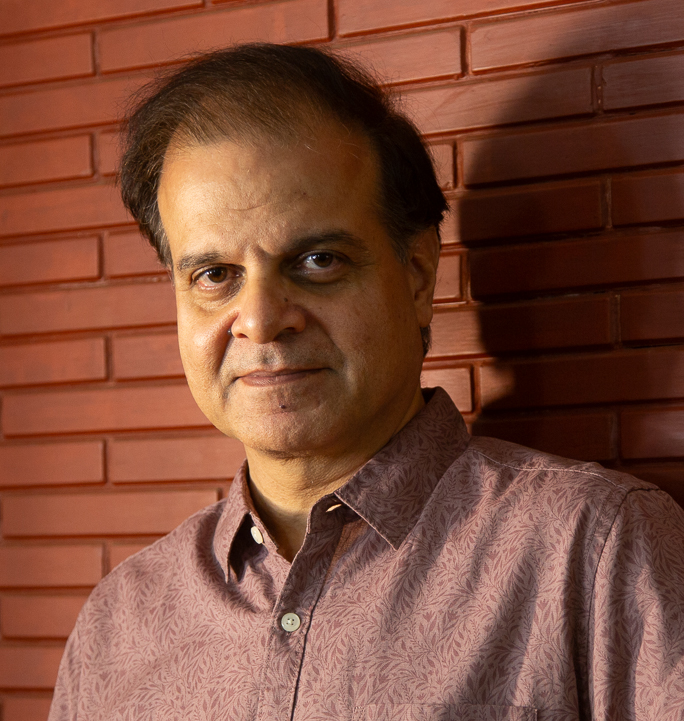
Namit Arora is a writer, humanist, social critic, and travel photographer. He grew up in Gwalior—known for its historic fort, its epigraphic evidence of zero, and Tansen. His proximity to zero—or shunya, zilch, nada—is a great source of pleasure to him. After IIT Kharagpur and a masters in computer engineering from Louisiana, he worked in Silicon Valley for two decades, at both failed startups and big corporations. Whether this made him any wiser is debatable, but it did allow him to take social science courses of dubious practical value at Stanford and to live, work, or travel in scores of countries, with yearlong stints in London and Amsterdam. He quit this profession in 2013 for a life of reading and writing and returned to India. For two years, he volunteered with the Delhi govt. to tackle civic problems; he led the drafting of Delhi’s solar energy policy and a task force on air pollution.
Namit’s writing has appeared in 3 Quarks Daily, The Caravan, The Baffler, The Wire, The Humanist, Philosophy Now, The TLS, The Philosopher, Scroll, Himal, and many anthologies (see his article archive and favorite books). He won the 3QD Arts & Literature Prize in 2011. For two years, 2004–06, he took time off to travel across India and began a photojournal that he has continued to evolve. His photos have been licensed by over 15 museums, 40 academies, and 60 publishers. His videography includes River of Faith, a documentary on the Kumbh Mela. He taught at the Adianta School for Leadership & Innovation, and spoke at Nirmukta Thinkfest 2015 and TEDx Gurugram 2016.

Namit has authored four books: (1) Speaking of History: Conversation about Indian’s Past and Present (with Romila Thapar), (2) Indians: A Brief History of a Civilization, (3) The Lottery of Birth: On Inherited Social Inequalities, and (4) the novel A California Story (US) / Love and Loathing in Silicon Valley (India). In 2024, he wrote and anchored Indians, a history web series in ten episodes. He is on Twitter, Facebook, YouTube, and Email.
Recent Posts from Author
-
Wise Man Socrates

Socrates, like Jesus and the Buddha, never committed his ideas to writing.* Our main sources on him are Plato, his student, and Xenophon, the historian. The picture that emerges from their accounts make him perhaps the greatest man of Classical Greece. This is by no means an original insight, but one that I was able to convince myself of many years ago.Socrates is justly famous for declaring that the unexamined life is not worth living, and for his dialectic method of inquiry, the Socratic Method. With Socrates, the central problem of (Western) philosophy shifted from cosmology to the formulation of a rule of life through understanding, to a practical use of reason. He upheld self-knowledge and the supremacy of the intellect, insisting that one must work hard to discover the right and wrong. As the Apology relates, Socrates advocated the tending of one’s soul, to make it as good as possible – and not to ruin one’s life by putting care of the body and possessions before care for the soul.**
Socrates was no retiring ascetic but an urbane intellectual of aristocratic lineage, a man of the world, famed for his practical wisdom, modesty, self-control, generosity, alertness, and integrity. “There was no complacent self-righteousness of the Pharisee nor the angry bitterness of the satirist in his attitude toward the follies or even the crimes of his fellowmen. It was his deep and lifelong conviction that the improvement not only of himself but also of his countrymen was a task laid upon him by his God, not to be executed with a scowling face and an upbraiding voice. He frequented the society of promising young men, and talked freely to politicians, poets, and artisans about their various callings, their notions of right and wrong, the matters of familiar interest to them.”**
-
Death in the Afternoon
(Ruchira Paul’s excellent post on the barbarity of “dog fighting” as a human sport reminded me of a bullfight I saw in Aug 1995.)
 A hot Sunday afternoon in Mexico City. The largest bullring in the world is packed with feisty locals. Restless, they whistle and hoot before the main event when emotions run high and which, oddly for Mexico, begins on time. A quick ceremonial parade by the human performers, and the first marked bull is unleashed into the ring. Today, three matadors will tackle six bulls, and for the first time ever, a female matador (from Spain) will perform in Mexico.
 In the first act, three assistants to the matador, the banderilleros, in gaudy costumes reminiscent of sixteenth century Spanish courtiers, enter the ring and start waving purple capes. By provoking the bull into empty chases, their job is to tire out the proud animal, weighing nearly half a ton. From the flanks, a matador takes note of the bull’s temperament.
-
Peter Brook’s Mahabharata
 Earlier this year I saw Peter Brook’s Mahabharata for the third time in fifteen years. Each time my admiration for it has grown. Not only is the epic itself among the greatest stories ever told, Brook’s stage production is sublime too. I consider it one of the greatest dramatic productions of all time. Its notable lack of appeal to Indians, except to a sliver, may be because it is in English and stars mostly non-Indian actors (including, heaven forbid, some black Africans in major roles!), not to mention that it treats the epic simply as a great work of literature, without the cloying religiosity that has informed most Indian dramatizations (with predictable “box-office” success).
Its international, multi-racial cast is fitting, driving home the point that the Mahabharata is both a universal story and the heritage of all humanity. Brook wrote the script with Jean Claude Carriere, an accomplished student of Buddhism, and it brings out some of the best philosophical and existential dilemmas of the epic. Costumes are tasteful, music score hauntingly beautiful, dialog taut and poetic. Battle scenes are creatively shown, like the Chakravyuh formation in war that traps Abhimanyu to his death.
 One thing I noticed more this time—which you won’t find in popular Indian renditions—is Krishna’s ambivalent role in the story (he’s not “cute” either). Nor is he above cheating and murderous advice (for example, to kill Karna when he is down, to hit Duryodhana’s thigh, to sacrifice Bhima’s son). The conclusion is inescapable: the Creator too is flawed, much like His creation. In the end, with the catastrophic destruction of the war in which nearly everyone is killed, we wonder if Arjuna’s doubts were any less profound than Krishna’s “divine truths”. Was it all worth it? Should one aspire to act without attachment to the fruit of the action? A perfectly defensible interpretation is that Krishna brainwashes Arjuna into “understanding” his duty (or dharma), after which the great warrior exhibits no further doubts—hardly a commendable state.
 -
On Shooting People
Shooting with a camera, that is. Most regular readers of this blog are probably aware of my large collection of travel photos on shunya.net. About a month ago, a man from Germany emailed me this note:
May I just politely ask you who gave you permission to post the images of all these people on the web? Have you ever asked them for their consent – some of your pictures really look like they were snapshots or secretly taken – even of people in the most miserable situations.
How can you bear people praising your photographic “skills” – when you just took from poor people what others would never yield: their very sphere of privacy and personality.
Category: Photography -
Size Matters!
 For ages now, men have made women feel self-conscious, nay worthless, making them obsess over the size of their, er … various body parts. Whatever the dimensions of a body part, they weren’t right today, and — we men artfully made sure — never would be. Women acquired the fine art and the wisdom of dolling themselves up — even getting nips, tucks, and implants — to be able to please our blessed eyes. We stoked their deepest fears and anxieties. With one sharp, well-timed glance or comment, we turned them into a whimpering heap of self-hatred and turmoil. Ah, how wonderful, how pleasurable, this sublime sense of control. Surely this is what Nietzsche had meant by man’s will to power.
But, if history is any guide, golden ages do not last. Women may have just found the Achilles heel of men, one that hangs between their legs. Unless you live in a cave (or without email, increasingly congruent), you receive spam emails about penis enlargement — pills, pumps, patches, etc. Size does matter, they reveal, with stats on women’s preferences and smiling women proclaiming, well, large member benefits. The emails promise all sorts of gains — sex appeal, heightened libido, even saving marriages — all as easy as 1-2-3! “Be a Real Man” and “she will love you more than any other guy.” Related pills promise to boost the man’s fluid volume, to help him “shoot like a porn star” (move over gun slingers of the Old West) and to drown her with, umm … his fluid (of course she likes that feeling). For the New Age man there are organic, pesticide-free herbal alternatives, with a green label to boot. (That’s harmony with nature; Marcus Aurelius would surely have approved.)
Men are definitely buying this stuff, else why would there be so much selling? A lot of women are pleased with this development. Some are quietly rejoicing with this expose of men’s insecurities — a more level playing field at last! Just as women buy fashion magazines that feature unreal women, men consume porn that features unreal men. “This restoring of chi, or balance”, said a woman interviewed by Shunya’s Notes, “gives me a deep sense of catharsis.” Another woman, trying hard to conceal her elation, confided, “I secretly saw my husband browsing a website that sells those pills. Tears welled up in my eyes. I felt this moment of spiritual connection with his insecurity.”
Category: Humor -
Diary of a Bad Year
On this 4th of July, here is an excerpt from a longer excerpt of JM Coetzee’s new novel, Diary of a Bad Year, due out in Jan 2008.
When the phrase “the bastards” is used in Australia, its reference is understood on all sides. “The bastards” was once the convict’s term for the men who called themselves his betters and flogged him if he disagreed. Now “the bastards” are the politicians, the men and women who run the state. The problem: how to assert the legitimacy of the old perspective, the perspective from below, the convict’s perspective, when it is of the nature of that perspective to be illegitimate, against the law, against the bastards.
Opposition to the bastards, opposition to government in general under the banner of libertarianism, has acquired a bad name because all too often its roots lie in a reluctance to pay taxes. Whatever one’s views on paying tribute to the bastards, a strategic first step must be to distinguish oneself from that particular libertarian strain. How to do so? “Take half of what I own, take half of what I earn, I yield it to you; in return, leave me alone.” Would that be enough to prove one’s bona fides?
Category: Fiction & Poetry -
The Burning Ghats of Varanasi
(For a significantly modified and expanded version of this post, please click here.)
 Varanasi (Benares, Banaras, Kashi), on the left bank of the Ganga (Ganges), is one of the seven sacred cities of the Hindus. Among “the oldest continuously inhabited cities of the world, its early history is that of the first Aryan settlement in the middle Ganga valley. By late 2nd millennium BCE, Varanasi was a seat of Aryan religion and philosophy and a commercial and industrial centre famous for its muslin and silk fabrics, perfumes, ivory works, and sculpture.”
 It was the capital of the kingdom of Kashi during the Buddha’s time (6th century BCE), who, after achieving enlightenment, gave his first sermon at nearby Sarnath (it is said that he purposely avoided this hotbed of Brahmanism). The Chinese traveler Hiuen Tsiang visited Varanasi in c. 635 CE and saw it as a centre of art, education, and religion. The city, he wrote, extended for about 5 km along the western bank of the Ganga.
 -
Five Chinese Classics
Have you read, or heard of, the great classical Chinese novels written between 14th and 18th centuries? Still part of folk culture, they’re known to most Chinese. I learned of them and their contexts while reading The Search for Modern China by Jonathan Spence. Here are five of them:
 Journey to the West: “China’s most beloved novel of religious quest and picaresque adventure” … published in the 1590s in the waning years of the Ming dynasty, when “essayists, philosophers, nature poets, landscape painters, religious theorists, historians, and medical scholars all produced a profusion of significant works, many of which are now regarded as classics of the civilization.” The novel’s hero, “a mischievous monkey with human traits … accompanies the monk-hero on his action-filled travels to India in search of Buddhist scripture.” * It’s “a first-rate adventure story, a dispenser of spiritual insight, and an extended allegory in which … pilgrims journeying toward India stands for the individual journeying toward enlightenment.” Indeed there aren’t many books in which “go west, young man” would be a call to go to India. 🙂
Golden Lotus: Published anonymously in early 17th century, this is a “socially elaborate and sexually explicit tale, the central character (who draws his income both from commerce and his official connections) is analyzed through his relationships with his five consorts, each of whom speaks for a different facet of human nature.” It can be read as “allegory, as a moral fable of the way greed and selfishness destroy those with the richest opportunities for happiness; yet it also has a deeply realistic side, and illuminates the tensions and cruelties within elite Chinese family life as few other works have ever done.” *
-
Arundhati Roy on Her Money
From an interview in Tehelka, “the people’s paper” of India (Nov ’05):
 Arundhati Roy: As for money, I have tried to take it lightly. Really, I have tried to give it away, but even that is a very difficult thing to do. Money is like nuclear waste. What you do with it, where you dump it, what problems it creates, what it changes, these are incredibly complicated things. And eventually, it can all blow up in your face. I’d have been happier with Less. Yeh Dil Maange Less. Less money, less fame, less pressure, more badmashi. I hate the f***ing responsibility that is sometimes forced on me. I spent my early years making decisions that would allow me to evade responsibility; and now…
Tehelka: You gave your Booker money to the NBA. Your Sydney prize money to aborigine groups. Another award money you gave to 50 organisations who are doing exemplary work … You gave away your money … Very few people do that …
Category: Books & Authors -
Youth
(A Poem by Czeslaw Milosz )
Your unhappy and silly youth.
Your arrival from the provinces to the city.
Misted-over windowpanes of streetcars,
Restless misery of the crowd.
Your dread when you entered a place too expensive.
But everything was too expensive. Too high.
Those people must have noticed your crude manners,
Your outmoded clothes, and your awkwardness.There were none who would stand by you and say,
Category: Fiction & Poetry -
Buggering Khushwant
 Few Indian writers can match the irreverence, acerbic wit, and bawdy humor of Khushwant Singh. Here is his latest piece at 92. He is not well-known outside India but there is much more to the man than this light-hearted piece conveys. He has secured his place as a major Indian novelist, journalist, and historian of the Sikh experience. Read this article, for instance, to see another side of him. A compelling, if less upbeat, viewpoint on his legacy has been put forward by Amardeep Singh.
I crave the forgiveness of my readers for writing on a subject which is taboo in genteel circles. I also apologise in advance for using words which some people may find distasteful. I wouldn’t be doing so if the end of my tale of woe was not so comic.
It all started during my recent summer vacation in Kasauli. I woke up one night with a queasy feeling in my stomach. Half asleep, I tottered to the loo to rid myself of my sleep-breaker. When I got up from the lavatory seat to flush out the contents, I was shocked to see I had passed a lot of blood with my stool. “Shit!” I said to myself, suddenly wide awake. The rest of the night was wasted in contemplation of the end. I had had a reasonable innings, close to scoring a century, so no regrets on that score. Was I creating a self-image of heroism in the face of death? That vanished on the following day as more blood flowed out of my belly.
-
Shunya’s Notes is Evolving!
 As they say, all good things mutate in the middle.* It gives me great pleasure to announce that after being a solo blog for almost eight months and 72 posts, Shunya’s Notes is mutating into a group blog. Please join me in welcoming four new bloggers to Shunya’s Notes. For more about them, click on their names or contributor links on the left.
- VP joins us from Neutral Observer. With Attitude aplenty, this ex-physicist has a penchant for prose brimming with empirical gravity. We’ll be watching vee-pee!
- Usha Alexander was a bass guitarist in a garage band until she met me. She still persists with her interest in anthropology, science, and literature, while singing soprano in a world music choir.
- Ruchira Paul, a talented painter and the founder of Accidental Blogger, has established a high bar for political, social, and literary commentary. Better steer clear of her, you left-wing ideologues and right-wing religious types!
- Dukhiram looks far less dukhi than one might imagine. When not entertaining, educating, and exhorting (as is his custom), he devises better ways of searching for needles in a haystack.
In the spirit of this mutation, I will no longer be using Shunya as my nom de plume on this blog. Happy blogging, new contributors!
* (Ok, I don’t know anyone who says that but it’s true; else we wouldn’t be here.)
Category: Daily Noise -
A Portrait of Kerala
 Kerala is known for its long tradition of religious amity, high literacy rate, high social status of women (due in part to its former matrilineal system), and a relatively decent public health service. In 1957, it democratically elected the first communist government in the world. Owing to its high population density, long exposure to foreigners, and a mercantile spirit, lots of Keralites travel abroad for work, most to the Middle East.
 Hindus, with their diverse sects and practices, form the majority. Christians, over a third of the population, belong to the Orthodox Syrian, Roman Catholic, and Protestant churches. While Muslims reside throughout the state, the Mappilas of the Malabar Coast constitute Kerala’s largest Islamic community (the earliest known Indian Muslim community, having existed since the 8th cent. CE). Jains live mainly in the far north. The Jewish community remains a small, exclusive sect, centered around an ancient synagogue at Cochin.
 First mentioned as Keralaputra in a 3rd-century-BCE rock inscription of Ashoka, the region was famous among the Greeks and Romans for its spices (esp. pepper). During the first five centuries CE, it was a part of Tamilakam, and so partially controlled by the eastern Pandyas, Cholas, and Cheras. In the 1st century CE, Jews arrived and St. Thomas the Apostle visited (or so the Syrian Orthodox Christians believe). Arab traders introduced Islam in the 8th century. Under the Kulaśekharas (c. 800–1102), Malayalam emerged as a distinct language and Hinduism became prominent. The Cholas often controlled Kerala in the 11-12th centuries. Ravi Varma Kulaśekhara of Venad briefly ruled southern India in early 14th century. After his death, Kerala became a conglomeration of warring chieftaincies, among whom the most important were Calicut in the north and Venad in the south.
 -
Asian Art Museum, SF
 The Asian Art Museum (AAM) in San Francisco is one of the largest of its kind in the West. Interestingly, over half of its 15,000 pieces come from a single donor — Avery Brundage (1887-1975), an engineer-businessman from Chicago, Olympic athlete, sports official, art collector, and a philanthropist, who ran a real estate company and also headed the International Olympic Commission from 1952-72. He successfully opposed the US boycott of the 1936 Olympics in Nazi Germany, criticizing “radicals and communists” for the move. He was not only a racist and Nazi sympathizer, he even praised Hitler at a NY rally.
 But none of this kept him from accumulating some of the rarest and finest works of Asian art, with a special taste for Buddhist art (go figure!). For Indian art at least, the man seems to have gone for physical perfection. It’s not clear if he ever visited India, or had much insight into what he was collecting. These pieces probably bubbled up to the top of the art market in the West and he acquired them with a passion. Spanning three floors, the museum requires multiple visits to do justice to it. Here are ten selections from its South Asia gallery. Other galleries include The Persian World and West Asia, China, Southeast Asia, The Himalayas and the Tibetan Buddhist World, Korea, and Japan.
 The Bodhisattva Maitreya, 100-300; Pakistan / ancient Gandhara
“Maitreya is believed to be a powerful spiritual being who, when the time is right, will be born on earth in human form and become the next Buddha. Though little actual jewelry has survived from this early period, the elaborate ornaments, collar, necklace, and bracelets shown here provide evidence of what such jewelry looked like. Notice on the necklace the long-bodied centaurs.”
Category: Art & Cinema -
Respecting Religion
 Religious folks are a diverse lot. In their public acts, they exhibit a host of inspirations, both religious and secular. We can guess but we can’t usually be sure about the mix. Forget the average pious bloke, even a suicide bomber’s inspirations are rarely plain. Yet, to the extent a religious inspiration is evident in a public act — whether good or bad in its effect — what should we make of it?
Religion is so entwined with history that it’s hard to imagine what an alternate world would have been like. It is not sensible to say that the world would have turned out better (or worse) without it. When militant atheists like Harris, Dawkins, and Hitchens attack religion as pernicious and irrational, they tend to equate secular with rational. They forget that being secular (or an atheist) is not a positive virtue; it doesn’t make one more rational, kind, or caring. History is also replete with secular horrors.
Reacting to militant atheists, moderate atheists often wince and point out the mixed record of religion — that religiosity is not all bad; in many, it has also inspired charity, altruism, and resistance to inhumanity and injustice (e.g., the Civil Rights movement, Anglican Church on Apartheid, etc.). Without their religiosity, many of these folks may not have acted as they did. Religiosity can also hold society together, provide comfort and strength in trying times, etc. Moderate atheists call this “good religiosity” and prefer to object only to “bad religiosity”. As a corrective and a call for greater tolerance, this seems reasonable. We wonder: Is there a downside to this “mixed record of religion” argument?
Category: Religion -
Children of a Lesser God
A disproportionately large number of Indians have congenital defects and visibly stunted growth. The poorest of them are often abandoned by their families and/or forced to beg. Tourist and pilgrimage sites inevitably become their favorite stomping grounds. Why does it seem so much worse in India, even compared to the lower GDP nations of, say, East Africa (the only part of sub-Saharan Africa I have seen)?
Excluding the unlucky rolls of genetic dice (many of which can be avoided by a medical pre-screening), most birth defects are due to maternal malnutrition and substance abuse, as well as exposure to toxins, pollution and hazardous waste. In India, the latter may be no less significant. Given India’s worsening urban environments and anemic healthcare, one has to stretch facts, ignore evidence, and be a determined optimist to see light at the end of this tunnel. At least for the foreseeable future, India should remain the prime destination for photo ops of the kind below.


 Addendum: A regular reader of Shunya’s Notes, a geneticist, emailed to say that these photos are more likely to be of early childhood polio victims rather than congenital defects, except the second photo which is “more likely to be a congenital disorder because both the upper and lower limbs in the victim appear to be severely deformed presenting almost a case of classic clubfoot which involves a congenital upward and inward twisting of the foot. Whereas in the other photographs the victims appear to have a lower motor neuron disease which is most likely Poliomyelitis and the upper part of the body remains comparatively unaffected … unless one can do an Electromyography (EMG) on the victims, [one can’t be certain].” Since they still fall within the ambit of this post’s title, I am inclined to leave them as they are.
 -
Jerry Falwell, BIH
 Jerry Falwell is dead. The news reports reminded me that besides the Moral Majority, he also founded a Christian madrassa called Liberty University. There are in fact scores of Christian madrassas in America, often with thousands of students enrolled. The big difference is that they are wealthier than their Islamic counterparts, market themselves more slickly, and have a lot more political power. I paused to glean some information from their websites — an act of masochism you might say — but for you, dear reader, no trouble is large enough. (Statutory warning: Text below might make you laugh and cry at the same time.)
Liberty University
“[The] world’s largest evangelical university, with over 20,000 students … [providing] the highest quality education in a distinctly Christian environment…. Liberty’s professors integrate a Christian worldview into every subject area. This biblical foundation is the cornerstone upon which we build academic excellence. Our faculty hold degrees from more than 400 colleges and universities. They join Liberty only after completing a rigorous interview process that confirms a born-again relationship with Christ … and a commitment to teaching excellence.”
Bob Jones University
“[BJU] exists to grow Christlike character that is Scripturally disciplined; others-serving; God-loving; Christ-proclaiming; and focused Above…. Whatever field of study our students choose, they are taught the importance of having Christ at the center of their lives…. This emphasis is rooted in the University’s adherence to the Bible as mankind’s only source of faith … [BJU] continuously strives to be the best school it can be, to the honor and glory of Christ.”
Wheaton College
“A four year, residential, academically rigorous … college whose historic motto is “For Christ and His Kingdom”…. Committed to the principle that truth is revealed by God through Christ in Whom are hid all the treasures of wisdom and knowledge… We believe that God directly created Adam and Eve, the historical parents of the entire human race; and that they were created in His own image, distinct from all other creatures… [Our Physics program gives] students a fuller awareness of the structure and principles characteristic of the created universe… [we produce the] best science graduates in the nation [who] have a high tendency to earn Ph.D.s and enter scientific careers.”
Evangel University
“The mission of Evangel’s Department of Science and Technology is to provide a solid understanding of science, yet temper it with an appreciation for the majesty of God as revealed in the beauty and order of His creation…. Our faculty and staff are dedicated to helping our students fulfill their God-given potential. Most important of all, we want our students to know the Truth.”
Regent University
“[An] institution of higher learning that exists to bring glory to God the Father and His Son Jesus Christ through the work of the Holy Spirit. Our mission is … education from a global, biblical perspective in pivotal professions to equip Christian leaders to change the world, and to be a leading center of Christian thought and action…. Our students, faculty and administrators share a calling, founded on biblical principles … Our vision … is to provide Christian leadership in transforming society by affirming and teaching principles of truth, justice and love as described in the Holy Scriptures, embodied in the person of Jesus Christ and enabled through the power of the Holy Spirit. Soli Deo Gloria.
American Evangelical Christian University
“AECU believes that every God called person should have the opportunity to pursue a quality education at an affordable price. No matter what course of study you pursue, it is our goal to have you emerge as a disciple of Christ with a deeper … appreciation of the Christian faith.” -
James Nachtwey
 Among the most affecting and iconic works of photojournalism are those that capture the human experience at its extremities: war, famine, disease, torture, genocide. The best of these photographs reflect back to us our starkest human material, and bring into focus both the benefits and the costs of political events and policies. They give “a voice to those who would not otherwise have a voice [and] put a human face on issues which from afar can appear abstract or ideological.”
For various reasons, not many photographers operate in this space. One who does is James Nachtwey; he has produced an enviable body of work from our war zones and brought to light vital stories from around the world. He wanted above all to be a war photographer, “driven by an inherent sense that a picture that revealed the true face of war would, almost by definition, be an antiwar photograph.” Photography like his is much more than being at the right place at the right time — it requires a certain eye, a special way of looking at the world, which can recognize and distill a significant human experience into an image. Above all, it is a work of demanding intellect, honesty, and empathy.
Visit James Nachtwey’s website, read his bio, and hear his inspiring speech at the recent TED awards acceptance ceremony for 2007 (also explore other TED talks by some pretty smart people). I’ve chosen here a few of my favorite images from his website.
Category: Photography -
Encyclopedia of Life
A brand new addition to the joys of the Web is the Encyclopedia of Life, an ambitious, Noah’s Ark-like project where “the world’s scientists plan to compile everything they know about all of Earth’s 1.8-million known species of animals, plants, and other living creatures on one website, open to everyone.” Check out the overview video and its attractive sample pages on the Death Cap Mushroom, Yeti Crab, and Polar Bears, combining text, photos, video, audio, maps, and more.
 “It’s an interactive zoo,” said James Edwards, a biologist who will be
the encyclopedia’s executive director. … He hopes [that it] will have the same catalytic
effect the Human Genome Project has had on biology and genetics.The project [“unrivaled in scope”] will take about 10 years to complete and … is expected to fill about 300 million pages … [which] can be adjusted so that they provide useful information for both a child doing homework and a research biologist alike, with an emphasis on encouraging “citizen-scientists” to add their sightings.
Category: Science