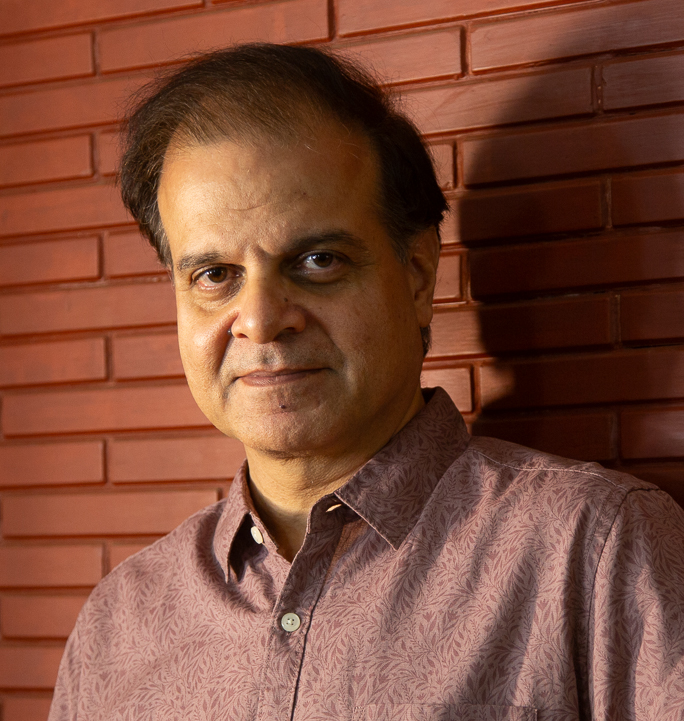
Namit Arora is a writer, humanist, social critic, and travel photographer. He grew up in Gwalior—known for its historic fort, its epigraphic evidence of zero, and Tansen. His proximity to zero—or shunya, zilch, nada—is a great source of pleasure to him. After IIT Kharagpur and a masters in computer engineering from Louisiana, he worked in Silicon Valley for two decades, at both failed startups and big corporations. Whether this made him any wiser is debatable, but it did allow him to take social science courses of dubious practical value at Stanford and to live, work, or travel in scores of countries, with yearlong stints in London and Amsterdam. He quit this profession in 2013 for a life of reading and writing and returned to India. For two years, he volunteered with the Delhi govt. to tackle civic problems; he led the drafting of Delhi’s solar energy policy and a task force on air pollution.
Namit’s writing has appeared in 3 Quarks Daily, The Caravan, The Baffler, The Wire, The Humanist, Philosophy Now, The TLS, The Philosopher, Scroll, Himal, and many anthologies (see his article archive and favorite books). He won the 3QD Arts & Literature Prize in 2011. For two years, 2004–06, he took time off to travel across India and began a photojournal that he has continued to evolve. His photos have been licensed by over 15 museums, 40 academies, and 60 publishers. His videography includes River of Faith, a documentary on the Kumbh Mela. He taught at the Adianta School for Leadership & Innovation, and spoke at Nirmukta Thinkfest 2015 and TEDx Gurugram 2016.

Namit has authored four books: (1) Speaking of History: Conversation about Indian’s Past and Present (with Romila Thapar), (2) Indians: A Brief History of a Civilization, (3) The Lottery of Birth: On Inherited Social Inequalities, and (4) the novel A California Story (US) / Love and Loathing in Silicon Valley (India). In 2024, he wrote and anchored Indians, a history web series in ten episodes. He is on Twitter, Facebook, YouTube, and Email.
Recent Posts from Author
-
An MSc and a Ph.D
(An excerpt from an account of my travels in Jordan a few months before 9/11)
 Two days earlier, on the bus from Amman to Petra, I met Mohammad, 27, and Zayed, 29. Muhammad wore jeans and a long-sleeved shirt, a moustache and a two-day stubble on his square face. Zayed, dressed in “business-casual” attire, had a slim, clean-shaven face. Both spoke a halting English. I initially mistook them for old friends but they had just met on the bus. Category: Travel
 -
Servitors of the Divine Consciousness
 In Jan ’06, I visited Auroville for the second time (first in ’96), but my interest was still purely anthropological. Yet again, Auroville—a township in Tamil Nadu founded in 1968 by the Mother (Mirra Alfassa), a French collaborator of Sri Aurobindo Ghose and a great believer in his teachings—struck me as an immensely audacious and, in some ways, a naively idealistic experiment.
 The Mother dreamed of a place where “all the fighting instincts of man would be used exclusively to conquer the causes of his sufferings and miseries, to surmount his weaknesses and ignorance, to triumph over his limitations and incapacities … where the needs of the spirit and the concern for progress would take precedence over the satisfaction of desires and passions.” Auroville aspires to be such a place, “a universal town where men and women of all countries are able to live in peace and harmony, above all creeds, all politics, and nationalities. The purpose of Auroville is to realize human unity.” Today it is home to 1800 people (600 Indians) from 35 countries in over 100 settlements.
-
On Photography: Truth, Lies, and Photos
(This is a follow-on to part one of my notes on photography)
 Many urban middleclass Indians I know are peeved by what they see as a staple of photography on India: squalor, poverty, lepers, fakirs, the deformed. Their India is not like that, and they harbor a knee-jerk hostility to such images. There are so many more suitable subjects of photography, they say, this isn’t the full story (what is?). One cousin was more articulate: the West, he said, has employed such a lens for decades to perpetuate negative stereotypes of India. It is an act of power. The white man came, and still comes, with little love in his heart. His jaundiced eye only sees the exotic and the grimy, making India seem primitive and medieval.
 -
Our Moral Compass
The gazillions of regular readers of Shunya’s Notes may find interesting a recent exchange of views between me and Ruchira Paul on Accidental Blogger. It began with my comment to a post by Ruchira on a book called Moral Minds by Marc D. Hauser, and then moved on to somewhat tangential discussions on the roots of morality, and secular and religious ethics.
-
Amartya Sen on Globalization
 Where does “our own” Nobel laureate in economics stand on globalization? Earlier this year, I reviewed The Argumentative Indian by A Sen. A wide ranging book with sixteen essays on Indian culture, history, and identity, it often brims with that perennially precious thing: commonsense. It also reveals his abiding love of India. Here, too, Sen tackles globalization from his unique vantage point as an economist. Below is an extract from my review that examines his views on the topic.
 Some fears about globalization, Sen says,
-
Who’s That Pretty Pachyderm?
 One of the pleasures of traveling in India is to unexpectedly run into elephants. Almost always decked out by the mahout, they’re typically found blessing visitors at temples and festivals, strolling down a street, or giving rides at tourist sites and national parks. I’ve also seen wild herds in the African savanna and tropical forest, and in the grassy woods of Uttaranchal and the hills of Kerala. But elephants never cease to amaze and delight me.
 That elephants are smart is common knowledge, but a new study has moved them into a super-elite club of smart animals: the great apes and humans
-
Melting Girls and Serpent Women
 Two days ago I went on a day trip to Pushkar, a Hindu pilgrimage site, from Jaipur. It has what is said to be the only temple to Lord Brahma in the world. Bathing ghats encircle Pushkar Lake, which, like the umpteen other polluted lakes and rivers in India, is believed to have miraculous healing and purifying power. Though alcohol and meat are banned in this holy town, soft drugs are tolerated (Lord Shiva partakes of it himself!) and are a major draw for Westerners. Pushkar’s history goes back a long way but all its temples date from modern times; the earlier buildings were summarily razed by the bad guy Aurangzeb.
  This was my second visit, occasioned by the annual, weeklong Pushkar camel fair that attracts over 250,000 visitors from India and abroad. Villagers turn up for both business and pleasure. In the animal market, amid women gathering camel dung for fire and children frolicking in tanks that hold drinking water for the camels, I felt transported back by decades, save for the large telecom company ads and the camcorder-toting tourists.
 -
A Day Trip to My Alma Mater
 I got a B.Tech from the Indian Institute of Technology, Kharagpur (IIT, KGP). Sixteen years after graduation, I visited it again from Kolkata during Puja 2005.
Most students had gone home but the institute, though fairly deserted, still evoked a flood of memories. But this felt different from nostalgia (it’s been a while since I felt any nostalgia for the IIT), which I find plentiful in most IITians I meet (“the best four years of my life”, they typically say). This gap may be because I have long viewed my IIT stint as, at best, a passage to a richer life in more ways than one (for which I feel fortunate but not nostalgic; for me most four year periods since have been better), and, at worst, a relative waste of time that played only a trifling role in my intellectual and moral development. I went again partly because places from our past teach us something about our present.
For an elite college that attracts some of India’s “sharpest” kids, its near total lack of liberal education now seems like a deprivation to me. That the IITs see no value in leavening technical instruction with the humanities should give us pause about the quality of its graduates. In my former department, only three non-professional courses are on offer today in four years, including English for Communication, which comes with eight other courses in semester one. The incoming freshman must take nine courses in the first semester and eight in the second! And all that while negotiating life away from home. How can he learn anything well? UC Berkeley averages three or four each semester. The IIT KGP curriculum offers nothing even on the history of global science and technology, nor on the unique challenges of technological development in India.
-
Thinkers Anonymous
A friend forwarded me this amusing piece. Not a clue who the author is. Enjoy.
Our Dignity and Rights
In today’s world, we often take for granted ideas like human dignity and human rights. Many of us hold them to be natural, inalienable, or universal. But we would do well to ask: where do human dignity and human rights come from? JM Coetzee reminds us in his Essays on Censorship that human dignity itself is,
… a foundational fiction to which we more or less wholeheartedly subscribe, a fiction that may well be indispensable for a just society, namely, that human beings have a dignity that sets them apart from animals and consequently protects them from being treated like animals … [it] helps to define humanity and the status of humanity helps to define human rights … an affront to our dignity strikes at our rights. Yet when, outraged at such affront, we stand on our rights and demand redress, we would do well to remember how insubstantial the dignity is on which those rights are based…
Category: PhilosophyNalanda University
(See my updated and expanded article on Nalanda University.)
 In July this year, I visited Nalanda in Bihar, India, one of the most spectacular archaeological finds on the subcontinent. Nalanda was once a famous Buddhist monastery and university. The region’s traditional history dates to the time of the Buddha and Mahavira (6th–5th cent. BCE). Nagarjuna, it is said, studied there.
 Reporting from Home
I’m a non-resident Indian (NRI). I left India in 1989 for a masters degree in the US. I then lived in N. California and W. Europe and had traveled to 50+ countries by late 2004, when I moved to India for two years to read, write, travel, and rediscover the country (I’ve since visited over 110 destinations in almost 20 states).
I recently thought of recording my pros and cons of living in India again after 15 years in the West (if I had never left India I would surely see things quite differently). What doesn’t appear below either didn’t impinge enough on my consciousness (or I’m yet to identify it for this list), or it wasn’t distinctive enough. (—Oct 2006)
Land of Two Rivers
“Punjab” comes from two Persian words, panj (“five”) and ab (“water”), thus signifying the land of five rivers (the Beas, Chenab, Jhelum, Ravi, and Sutlej). The present Indian state of Punjab is the result of two divisions: a) during the partition of India in 1947, and b) during 1966, when the majority Hindi-speaking areas were separated to form Haryana. “Punjab” is a misnomer today since only two rivers, the Sutlej and the Beas, lie in its territory. Chandigarh, a union territory, is the joint capital of Punjab and Haryana. ♣
Cultural clichés associate Punjabis with prosperity, hard work, straight talk, tolerance, a relaxed yet enterprising spirit, stellar contributions to Indian defense, politics, media, sports, and entertainment, a huge presence in Bollywood, truck/cab driving, dhabas and Punjabi food (the best known Indian cuisine worldwide), turban and beard, a butt of ethnic jokes, and a joie de vivre that manifests itself in the exuberant song and dance routines of the bhangra. Women here seem among the freest in the north. Literacy stood at 70% in 2001, higher than the Indian average of 65%. Sikh Gurdwaras are cleaner and more charitable and welcoming to outsiders than most temples and mosques I have visited. From the road, the harsh edge of poverty is visible here far less than in most parts of India.
On Photography: Which Thousand Words?
 If a picture says a thousand words, which thousand words does it say to whom? If we all wrote down what we hear, no two accounts would be the same. A picture of an antelope can tickle a palate, provoke wonder in the Lord’s creation, convey a medical factoid, illustrate the photographer’s technique, bore a teenager, etc. A picture of a destitute woman with child may provoke sympathy, wonder, or contempt (if she is seen as lazy, irresponsible with pregnancy, parasitic on society, etc.). The more “abstract” a photo, the wider its range of interpretations. So the question is: can a photographer convey a controlled moral message at all?
On the art of photography, we’ll do well to recall Wittgenstein: “What can be shown, cannot be said.” What a picture conveys, he suggests, cannot be fixed by words. Words are a subjective proxy for a picture, a separate creation with a life of its own.
In matters of appreciation, photography may well be closer to music. As forms of art, both are more abstract than, say, novels and films, which at least have words and ideas to latch on to. But novels and films are already notoriously subjective. The best writers know how hard it is to control interpretation. “The stories we write,” says JM Coetzee, “sometimes begin to write themselves, after which their truth or falsehood is out of our hands and declarations of authorial intent carry no weight. Furthermore, once a book is launched into the world it becomes the property of its readers, who, given half a chance, will twist its meaning in accord with their own preconceptions and desires.”*
The Idea of India
An Indian-American friend of mine recently asked me:
How did Indians themselves refer to India during the Raj? Did they call it “India”? I mean back then, it had independent state-like entities or “protectorates”, with kings and other legislative bodies, as well as what are now Pakistan and Bangladesh. So how did people talk about the whole thing? Or did they much? How, for that matter, did the British refer to it? And did Indians use the same words as the British did?
Today I thought of putting up here my [expanded] email response to him:
Gandhi’s “Inconsistent Pacifism”
 Last week the Norwegian Nobel Peace Prize committee made a rare and candid admission: “Our record is far from perfect … not giving Mahatma Gandhi the Nobel Peace Prize was the biggest omission” of its 106 year history, said Geir Lundestad, permanent secretary of the committee. “Gandhi could do without the Nobel Peace Prize,” he added wistfully. “Whether the Norwegian Nobel committee can do without Gandhi, that’s a different question.”
What is astounding is that Gandhi was short-listed for the prize in 1937, 1938, 1939, 1947 and just a few days before his assassination in 1948, but was never deemed worthy of it. Lundestad attributes this to the Euro-centrism of the Nobel committee back then, and their scant appreciation for the freedom struggles in the colonies. In the case of Gandhi, he said, committee members cited minor reasons like his “inconsistent pacifism” to deny him the prize.
Later the award would go to folks like Kissinger, Peres, and Arafat (only consistent pacifism there). Another dubious recipient, Elie Wiesel, is on record for calling the US invasion of Iraq “a moral obligation”. Too bad there is no provision for taking back a Nobel Peace prize!