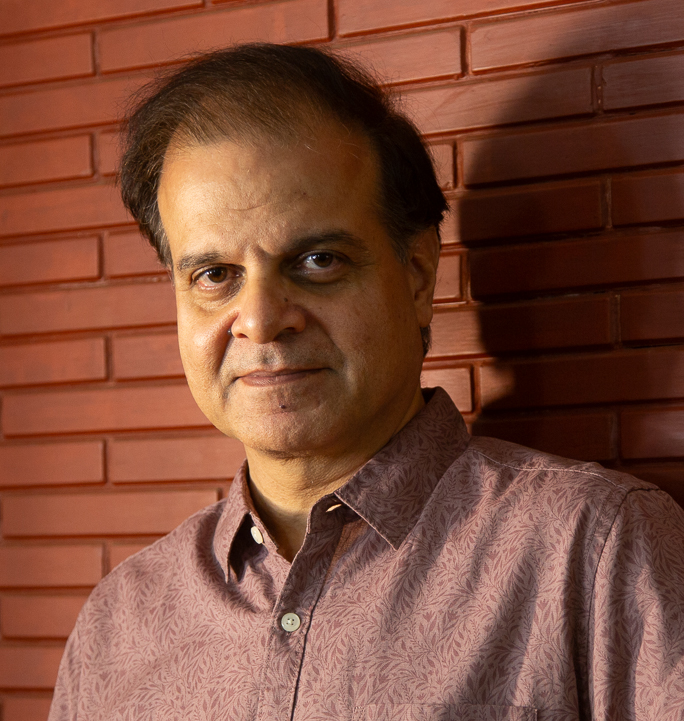
Namit Arora is a writer, humanist, social critic, and travel photographer. He grew up in Gwalior—known for its historic fort, its epigraphic evidence of zero, and Tansen. His proximity to zero—or shunya, zilch, nada—is a great source of pleasure to him. After IIT Kharagpur and a masters in computer engineering from Louisiana, he worked in Silicon Valley for two decades, at both failed startups and big corporations. Whether this made him any wiser is debatable, but it did allow him to take social science courses of dubious practical value at Stanford and to live, work, or travel in scores of countries, with yearlong stints in London and Amsterdam. He quit this profession in 2013 for a life of reading and writing and returned to India. For two years, he volunteered with the Delhi govt. to tackle civic problems; he led the drafting of Delhi’s solar energy policy and a task force on air pollution.
Namit’s writing has appeared in 3 Quarks Daily, The Caravan, The Baffler, The Wire, The Humanist, Philosophy Now, The TLS, The Philosopher, Scroll, Himal, and many anthologies (see his article archive and favorite books). He won the 3QD Arts & Literature Prize in 2011. For two years, 2004–06, he took time off to travel across India and began a photojournal that he has continued to evolve. His photos have been licensed by over 15 museums, 40 academies, and 60 publishers. His videography includes River of Faith, a documentary on the Kumbh Mela. He taught at the Adianta School for Leadership & Innovation, and spoke at Nirmukta Thinkfest 2015 and TEDx Gurugram 2016.

Namit has authored four books: (1) Speaking of History: Conversation about Indian’s Past and Present (with Romila Thapar), (2) Indians: A Brief History of a Civilization, (3) The Lottery of Birth: On Inherited Social Inequalities, and (4) the novel A California Story (US) / Love and Loathing in Silicon Valley (India). In 2024, he wrote and anchored Indians, a history web series in ten episodes. He is on Twitter, Facebook, YouTube, and Email.
Recent Posts from Author
-
The Birthplace of Ganesh?
(Text below written by Usha Alexander in May 06. For more pictures click here.)
 Dodi Tal, considered the birthplace of Lord Ganesh, is a lake in Garhwal, western Uttaranchal. We hiked 44 km in 3 days, going up and down from about 5,000 ft to 11,000 ft, where we camped near the lake. Unfortunately, it was drizzly or overcast the whole time, so we couldn’t view the snowy peaks all around. Still, the walk was incredibly beautiful, through the luminously green, high mountain woodlands of the early rainy-season, the cliffs punctuated by streams of clear water gushing from the rocks, with breathtaking drops falling away on one side of the path.
 We had asked for two people to accompany us: a guide/cook and a porter, but when they turned up on the first morning, there were five of them! It seemed like overkill for only the two of us, but they all had large packs stuffed with provisions for our trip and we figured we couldn’t turn any of them away, denying them their day’s wages [Rs 225/$5]. So, we hiked up with an entourage of five men—a bit silly, but we had fun; and, as it turned out, their knowledge and assistance was invaluable to us lowlanders. The cook made hot breakfast and dinner each day; lunch was cobbled together in sporadic and makeshift chai stalls; one night they cooked a local wild veggie that tasted like asparagus.
 -
Watching Movies – I
In the last eight weeks, I’ve seen over a dozen films. For the gazillion diehard fans of Shunya’s Notes, I thought I’d share their names and rate them on a 5-star scale. I don’t watch a movie unless I’m reasonably sure it won’t insult my intelligence, so most turn out to be satisfying enough and worth seeing (at least 3 stars). Call me a snob but I stand with Shyam Benegal in calling mainstream Bollywood / Hollywood cinema “a form of retarded art” and I’ve largely avoided it for years (except the odd film I see for social or anthropological reasons, and that rare exception to the rule).
The Motorcycle Diaries *****
Category: Art & Cinema -
The Enlightened Romantic
 The Enlightenment began admirably by liberating men from despotic rulers, slavery, and serfdom, reducing superstition, the abject hold of religion, and creating the framework of human rights—its legacy is evident in present day social struggles. Inspired in part by the newly acquired scientific method, it also suggested that history can have a design, that it can converge to a universal civilization where men would come to acquire the same values, only error and prejudice block the path to the perfect society. It transformed human thought and action by nurturing the ideas of linear progress and ‘perfectibility’ of man. People can live by reason alone, once they give up superstition and fanaticism; mathematics and natural science will ultimately yield solutions to the moral, social, political and economic problems of humankind; scientific and ‘objective’ principles can steer history towards compatible, rational ends. Such ideas, in inflamed forms, influenced communism and numerous other excesses of secular faith. An immoderate love of social ideals, particularly in the name of progress or reason, often breeds its own tyrannies.
  Romanticism rebelled against the ideological optimism of the Enlightenment: none can live by reason alone; people are also shaped by their roots, homeland, ties of blood and marriage, experiences, temperament and tradition—and other submerged suprarational forces integral to humans—which inform their various, at times, incommensurate ends. The logic of science does not extend to human behavior. “Values are not discovered, they are created; not found, but made by an act of imaginative, creative will, as works of art, as policies, plans, patterns of life are created.” Diversity calls for celebration – there is merit in the age-old corporate solidarities and cultural mores by which human society holds together. It championed plurality of values, cultural history, and rejected the evaluation of civilizations by a single yardstick. This was a blow to the central Western belief thus far—religious or secular—that true human values are universal, immutable, timeless, that a perfect society was, in principle, realizable. Alas, in preaching tolerance for the diversity of values and aspirations, Romanticism, at times, swung towards extreme forms of relativism, nationalism, chauvinism, and irrationalism.
 We are the children of both the Enlightenment and Romanticism, shift back and forth between them. Mine-fields lie at the extremes of each; we would do well to tread the middle ground, to survey the fault lines. In his celebrated works, Dostoevsky rationally interrogated the Reason of the Enlightenment, much as Foucault did later: “What is this Reason that we use? What are its historical effects … limits … dangers? How can we exist as rational beings, fortunately committed to practicing a rationality that is unfortunately crisscrossed by intrinsic dangers? … this question … is both central and extremely difficult to resolve. In addition, if it is extremely dangerous to say that Reason is the enemy that should be eliminated, it is just as dangerous to say that any critical questioning of this rationality risks sending us into irrationality.” Only the exercise of reason, for instance, reveals the dangers in schemes that aim to rationalize society (or our conduct). Here are some worthy quotes:
-
The Dilwara Temples
 Many Indians claim that the Dilwara Jain temples of Mt. Abu are a more magnificient achievement than the Taj Mahal – both were stunningly ambitious, state-sponsored, multi-year, monumental, marble-work projects – but the claim is an imponderable to me. One difference, however, springs to mind: while thousands of art lovers and devotees also worked for a generation on each of the two Dilwara temples, the Taj, proof of an emperor’s inability to rationally accept his lover’s death, was built largely by hired men. I can understand a man’s desire for a memorial to his lover; I also believe that a modest memorial need not be any less meaningful, but no, size clearly mattered to Shah Jehan. He had to divert enormous resources of state to fund his absurd private infatuation.
 While I think the Taj is rather sublime – I am awed by its beauty each time I visit – the so-called “romance of its inspiration” bugs me. For the untold thousands who labored on it, Shah Jehan didn’t even have the magnanimity to dedicate the Taj to, say, “all the lovers of Hindustan,” or something similarly inclusive. The poet Sahir Ludhianvi, speaking for the masses, famously said of the Taj: “Ik shahanshah ney daulat ka sahaara ley kar / Ham ghareebon kee mohabbat ka uraaya hai mazaaq” (An emperor relying so on his wealth / Has ridiculed the loves of the poor like us). On the other hand, the Dilwara temples, built half a millennium before the Taj, seem to me expressions of a fairly democratic religiosity.
-
On History and Historians
‘To be ignorant of what occurred before you were born,’ Cicero declared, ‘is to remain always a child. For what is the worth of human life, unless it is woven into the life of our ancestors by the records of history?’ A good historian begins with the hard facts on public events and fragments of cultural life. But it takes more than what can be taught to become a great historian. He must also possess sensitivity, imagination, depth of perception, distance, and that uncanny ability to synthesize vast bits of knowledge, the kind found in great novelists. He must attempt to enter the society he studies, to see the world as its members saw it, and understand, to the extent possible, what it was like to live in it. He must examine the psychology, morals, aspirations, and assumptions of ordinary people.
The conception of man as an actor, a purposive being, moved by his own conscious aims as well as causal laws, capable of unpredictable flights of thought and imagination, and of his culture as created by his effort to achieve self-knowledge and control of his environment in the face of material and psychic forces which he may use but cannot evade—this conception lies at the heart of all truly historical study.
[—Isaiah Berlin]Category: History -
The Tsunami of 2004
 Two years ago today, the giant Indian Ocean Tsunami struck and claimed over a quarter million lives. Somewhere a mother lives who cannot forget the horror of the raging sea and the moment when a little hand slipped out of her grip, never to be united again.
 A year ago, I came across this evocative Tsunami memorial in Kanyakumari, a town at the southernmost tip of India. Over a thousand people died here. I put this up today as my own little memorial for a great humanitarian disaster.
Category: Daily Noise -
The Carvakas
It comes as a surprise to many that in ancient “spiritual” India, atheistic materialism was a major force to reckon with. Predating even the Buddhists, the Carvaka is one of the earliest materialistic schools of Indian philosophy, named after one Carvaka, a great teacher of the school. Its other name, Lokayata, variously meant “the views of the common people,” “the system which has its base in the common, profane world,” “the art of sophistry,” and also “the philosophy that denies that there is any world other than this one.” The founder of this school was probably Brhaspati.
The Carvakas sought to establish their materialism on an epistemological basis and their thought resembles that of British empiricist and skeptic David Hume, as well as of logical positivists. The Carvakas believed sense perception alone as a means of valid knowledge. The validity of inferential knowledge was challenged on the ground that all inference requires a universal major premise (such as “All that possesses smoke possesses fire”) whereas there is no way to reach certainty about such a premise. The supposed “invariable connection” may be vitiated by some unknown “condition,” and there is no means of knowing that such a vitiating condition does not exist. Since inference is not a means of valid knowledge, all supersensible things like “destiny,” “soul,” or “afterlife,” do not exist. To say that such entities exist is regarded as absurd, for no unverifiable assertion of existence is meaningful.
-
Le Corbusier’s Chandigarh
I have welcomed very greatly one experiment in India: Chandigarh. Many people argue about it; some like it, some dislike it. It is the biggest example in India of experimental architecture. It hits you on the head and makes you think. You may squirm at the impact but it has made you think and imbibe new ideas, and the one thing which India requires in many fields is being hit on the head so that it may think. I do not like every building in Chandigarh. I like some of them very much. I like the general conception of the township very much but, above all, I like the creative approach, not being tied down to what has been done by our forefathers, but thinking in new terms, of light and air and ground and water and human beings. [-Jawaharlal Nehru. Speech, 17 Mar 1959]
 Chandigarh may well be India’s greatest achievement in urban town planning. But despite Nehru’s enthusiasm, and the evident success of the experiment, the Indian political establishment seems to have learned nothing from it. Chandigarh ought to have become the harbinger for more planned cities. What came instead was unplanned urban sprawl, dispiriting shanties, and creaking infrastructure, punctuated now by gated enclaves built for the rich by a land-grabbing mafia of private developers. That Chandigarh did not inspire a hundred planned cities points to a colossal failure of the Indian imagination.
 -
A Mousetrap for Metaphysics
About six years ago, after an obsessive, multi-year engagement with history and philosophy, I struggled with the following question: Is it possible to reduce the vast range of humankind’s metaphysical responses down to a few distilled outlooks that have shaped (and continue to shape) human culture? An elementary classification has been in vogue at least since Herodotus: the East and the West, but it is clearly untenable in light of the internal diversity of both the East and the West. Is there a better classification, I wondered, that is at once simple, non-geographic, and more comprehensive?
I was well aware of the danger of oversimplification. Even accomplished scholars are prone to finding seemingly profound but ultimately specious patterns in human affairs. Still, in the summer of 2000, amid the stacks of Stanford’s Green library, I devised a classification that has withstood my own scrutiny over time (it can surely be fine tuned). All of our metaphysical knowledge, I concluded then, is arrived at via one of these three distinct approaches: Orthodox, Suprarational, Rational.
-
The Rann of Kutch
 The Rann of Kutch, an area of 18,000 sq km, lies almost entirely within Gujarat along the border with Pakistan. The Little Rann of Kutch extends northeast from the Gulf of Kutch over 5,100 sq km. Once an extension of the Arabian Sea, the Rann (“salt marsh”) has been closed off by centuries of silting. During Alexander’s time it was a navigable lake, but is now an extensive mudflat, inundated during the monsoons, salty and cracked otherwise. Settlement is limited to low, isolated hills.*
When I visited the Rann in April, 2006, the highs were already soaring past 110 F. The best way to see it, as I did, is in a 4WD stocked with lots of water. Dotting the parched landscape are desolate desert-like encampments, where a family or two combine forces to eke out a living by mining salt from the saline ground water, the biggest local industry. Legend has it that when a salt worker dies and is cremated, the soles of his feet survive – a lifetime of salt pan labor bakes them so hard that even fire cannot fully burn them.* Tata lorries transport their salt to small trading villages along a railway line. In the dry season, such villages host veritable hillocks of salt as far as the eye can see, where it’s packed and sent out on trains.
-
City of Joy?
(Text below written by Usha Alexander in Oct 05. For pictures and more, click here.)

Calcutta is a difficult city to be in. With its illustrious past as the one-time heart of the British Empire in India, its seemingly endless roster of lettered luminaries, social activists, freedom fighters, entertainers, and scientists, with lush tropical forests and fields along the Gangetic delta as its backdrop, the city has long since fallen into a sad state of decay, where it stubbornly remains. More than in any other major Indian city, the grind of poverty, pollution, and desperation were front and center at all times during our visit. It felt like a city left behind. But people with close ties to Calcutta maintain that its intellectual life and revolutionary spirit are not dead. Given that its culture and education system still produce a disproportionate number of India’s scholars and artists even today, I suppose that must be true. Unfortunately, this isn’t evident to the casual visitor. What I saw were the destitute widows of the Calcutta cliché—society’s refuse—and sidewalks lined with sleeping families pickling themselves in the thick, black exhaust of autos, cars, and buses.We went during Durga Puja, the region’s most spectacular festival. At this time, every neighborhood constructs a pandal that depicts Durga, flanked by other gods, slaying a demon. For days these doll-like statues are fussed over, dressed up, prayed at, entered into competitions, and then with great fanfare and emotion, they are foisted into a nearby lake or river to dissolve back into the mud from which they were made. All day long during the week of the puja, loudspeakers all over the city hysterically amplify the beating of drums or sacred recitations—with interludes of film music—for those who somehow manage to retain their hearing. Frankly, to me the whole thing felt like just one arduously long, painfully loud puja, and I did not find it all that charming. Still, the joyful and festive spirit of the participants was frequently evident.
-
On Being Spiritual
Spirituality is cool these days. Its warm and fuzzy aura now appeals to more and more people in the West. Online dating sites abound with claims of being “spiritual but not religious”. Interest in eastern beliefs and native Indian practices has never been higher. Many now instinctively accord a sense of “spiritual wisdom” to ancient traditions. Self-help aisles in bookstores keep growing and routinely address a “spiritual void” many perceive in their lives.
Yet most people interested in spirituality, when asked, would be hard pressed to come up with what it means to be spiritual. Many would equate it with less or more progressive versions of their traditional faith, incorporating a subset of its ideas, symbols, and rituals; some might define it as a syncretic mix of multiple faiths; others may think of it as a non-denominational mystical feeling and reverence for a force larger than themselves, such as nature.
I have my own idea of spirituality, of course, and I consider some people more spiritual than others. Yet I rarely find an idea of spirituality that I wholly admire. Last year, for instance, the president of World Pantheism, which claims lots of luminaries on its roster, wrote to me to request use of some of my photos, “We are completely naturalistic and nature-oriented – our views go under several other names such as religious naturalism, naturalistic spirituality, eco-humanism, etc.” In my affirmative reply, I also noted my own thoughts about nature reverence:
-
The Giant Tortoises of Galapagos
 Tortoises are land-dwelling turtles. They are exclusively terrestrial and vegetarian reptiles. In folklore they represent slowness, determination, and long life. Though found all over the world, the majority of the 40-odd living species are confined to Africa and Madagascar. They are characterized by high, domed shells; heavy, elephant-like hind legs; and hard-scaled forelegs.*
 The largest of them, the giant tortoises—with shell lengths (measured along the curve) up to 1.3 m (4.25 ft) and weights up to 180 kg (400 lbs)—are now rare or extinct because they were slaughtered for meat, or their habitats were destroyed by people, or due to the introduction of non-native animals (pigs, goats, rats, etc.) that prey on the young or compete for food. Of the giant tortoises native to about thirty islands in the Indian Ocean, all are extinct except on South Aldabra Island. The 10 to 15 Galápagos tortoises, commonly considered races (or sub-species) of the species Geochelone Elephantopus, are either severely depleted or extinct.*
-
Omar Khayyam of Persia
In his lifetime, Omar Khayyam (1048-1131) achieved great fame as a master of philosophy, jurisprudence, history, medicine, astronomy, and mathematics. The Great Seljuq Empire owed the reform of its calendar to him. The result was the Jalali era (named after Jalal-ud-din, one of the kings)—’a computation of time,’ wrote Gibbon, ‘which surpasses the Julian, and approaches the accuracy of the Gregorian [calendar].’ He measured the length of the year as 365.24219858156 days, a number improved to 365.242196 days only in the 19th century and the current measure is 365.242190 days.
He not only discovered a general method of extracting roots of an arbitrary high degree, but his Algebra contains the first complete treatment of the solution of cubic equations which he did by means of conic sections. He was also part of the Islamic tradition of investigating Euclid and his parallel postulate. Arguing that ratios should be regarded as ‘ideal numbers,’ he conceived a much broader system of numbers than used since Greek antiquity, that of the positive real numbers. In many such areas, he furthered the remarkable work of al-Beruni. Commissioned to build an observatory in the city of Esfahan, he led a team of astronomers to do so.
-
Al-Beruni’s India
The first significant intrusion of Islam into India was led by Mahmud of Ghazni who, quite justifiably, lives in Indian history as a cruel and bloodthirsty fanatic, destroyer of temples, and plunderer of their wealth, but in his own dominion he was known as a patron of the arts, literature, and science (not unlike Genghis Khan who is a great and beloved hero in Mongolia today, gracing its currency, plazas, airports, etc.). He assembled in his court and the university he established at Ghazni (in modern Afghanistan) the greatest scholars and writers of the age.

One such scholar was al-Beruni (973-1048; another was Firdausi), “commissioned” by Mahmud of Ghazni to produce his monumental commentary on Indian philosophy and culture – Kitab fi tahqiq ma li’l-hind. “In his search for pure knowledge he is undoubtedly one of the greatest minds in Islamic history.”* Romila Thapar calls him “perhaps the finest intellect of central Asia … His observations on Indian conditions, systems of knowledge, social norms, religion … are probably the most incisive made by any visitor to India.” -
Rock Shelters of Bhimbetka
 In Aug 2005, I visited a remarkable site in Madhya Pradesh, India: the prehistoric rock shelters and paintings at Bhimbetka, discovered in 1957-58 by Dr. Vishnu S. Wakankar. Of the nearly 750 rock shelters, 500 or so are adorned with paintings; about 15 are open to the public, though few come due to their relative remoteness and lack of public transportation. The site, 45 km from Bhopal, is at the foothills of the Vindhya mountains and is surrounded by forests of teak and sal that had grown lush green in the monsoon season.
Bhimbetka remained a center of human activity from the lower Paleolithic times—the oldest paintings are believed to be 12,000 years old (a disputed estimate); the more recent ones date from the first millennium BCE. One can plainly see that the same surface was often used by different peoples at different times.
-
Global Democracy Index
The Economist magazine’s intelligence unit has come up with a Democracy Index that rates 165 states and 2 territories on their democratic character. It examines 60 indicators across 5 broad categories: electoral process and pluralism, functioning of government, political participation, political culture, and civil liberties.
Sweden emerges on top with eight European states in the top ten. USA, the oldest democarcy and its self-awoved messiah, only mustered the 17th spot, partly due to its eroding civil liberties. India, the largest democracy is ranked 35th, scoring its lowest marks on political participation and political culture. Notably, on both civil liberties and electoral process and pluralism, India scores better than the US.
Other notable ranks include Japan (20), UK (23), Italy (34), Brazil (42), Israel (47), Mexico (53), Indonesia (65), Palestine (79), Singapore (84), Turkey (88), Thailand (90), Russia (102), Pakistan (113), China (138), S. Arabia (159), and N Korea (167). Check out the report, rankings, and the methodology.
-
On Personal Responsibility
(This is a follow on to my earlier post on our dignity and rights.)
The modern age has overseen a great expansion of our rights. Global disparities remain but there is no dearth of people who believe that rights are a good thing (at least for the social group they identify with most, be it based on race, nation, class, culture). Countless rights commissions and tribunals, as well as some NGOs and the media, strive to preserve or enhance them, often on behalf of strangers across the world and often with remarkably heartening results. Clearly, talk of rights is now chic but what about obligations and personal responsibility? What good is the former without the latter? People can demand rights from their government, but who gets to demand personal responsibility from the people? What happens when our exercise of rights and freedom get increasingly divorced from personal responsibility?
-
Land of the Asiatic Lion
 The only lions in the wild outside Africa are in the Western Indian state of Gujarat in the Sasan Gir Forest Reserve, created in 1913 and accorded sanctuary status in 1965. Hundreds of Asiatic lions have been bred here and now number close to 350. Other notable fauna includes leopard, wild pig, spotted deer, nilgai, four-horned antelope, and chinkara (a type of gazelle). A large water hole contains a few crocodiles. The sanctuary lies in a hilly region of dry scrubland. Spread over 1,295 sq km, its vegetation consists of teak with an admixture of deciduous trees, including sal (Shorea), dhak (Butea frondosa), and thorn forests. ♣
 Lions were once plentiful in Asia, which explains their prevalence in folk stories like the Panchatantra. Even in the 19th century, they ranged from the Middle-East to Bihar. While the lion population at Gir has grown in recent years, they compete for habitat with 52 human settlements of various sizes inside the sanctuary. Livestock constitutes about 25% of the lion diet and this loss is tolerated by the locals (the dominant group is called Maldharis).