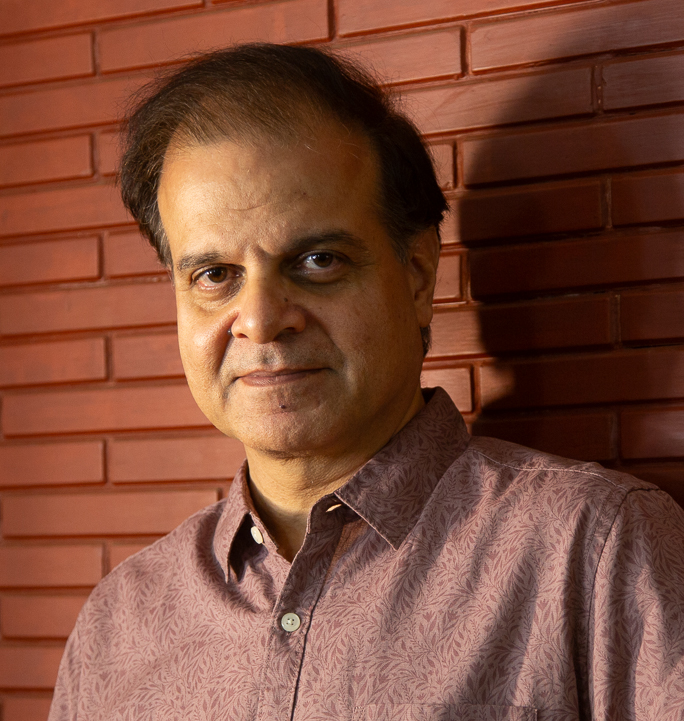
Namit Arora is a writer, humanist, social critic, and travel photographer. He grew up in Gwalior—known for its historic fort, its epigraphic evidence of zero, and Tansen. His proximity to zero—or shunya, zilch, nada—is a great source of pleasure to him. After IIT Kharagpur and a masters in computer engineering from Louisiana, he worked in Silicon Valley for two decades, at both failed startups and big corporations. Whether this made him any wiser is debatable, but it did allow him to take social science courses of dubious practical value at Stanford and to live, work, or travel in scores of countries, with yearlong stints in London and Amsterdam. He quit this profession in 2013 for a life of reading and writing and returned to India. For two years, he volunteered with the Delhi govt. to tackle civic problems; he led the drafting of Delhi’s solar energy policy and a task force on air pollution.
Namit’s writing has appeared in 3 Quarks Daily, The Caravan, The Baffler, The Wire, The Humanist, Philosophy Now, The TLS, The Philosopher, Scroll, Himal, and many anthologies (see his article archive and favorite books). He won the 3QD Arts & Literature Prize in 2011. For two years, 2004–06, he took time off to travel across India and began a photojournal that he has continued to evolve. His photos have been licensed by over 15 museums, 40 academies, and 60 publishers. His videography includes River of Faith, a documentary on the Kumbh Mela. He taught at the Adianta School for Leadership & Innovation, and spoke at Nirmukta Thinkfest 2015 and TEDx Gurugram 2016.

Namit has authored four books: (1) Speaking of History: Conversation about Indian’s Past and Present (with Romila Thapar), (2) Indians: A Brief History of a Civilization, (3) The Lottery of Birth: On Inherited Social Inequalities, and (4) the novel A California Story (US) / Love and Loathing in Silicon Valley (India). In 2024, he wrote and anchored Indians, a history web series in ten episodes. He is on Twitter, Facebook, YouTube, and Email.
Recent Posts from Author
-
Food, Inc.
If you see only one documentary this summer, make it Food, Inc. Here is Roger Ebert’s review, and the first 3-1/2 minutes of it.
 The next time you tuck into a nice T-bone, reflect that it probably came from a cow that spent much of its life standing in manure reaching above its ankles. That’s true even if you’re eating the beef at a pricey steakhouse. Most of the beef in America comes from four suppliers.
The next time you admire a plump chicken breast, consider how it got that way. The egg-to-death life of a chicken is now six weeks. They’re grown in cages too small for them to move, in perpetual darkness to make them sleep more and quarrel less. They’re fattened so fast they can’t stand up or walk. Their entire lives, they are trapped in the dark, worrying.
-
Dreyfus on Second Life
In this terrific article, Prof. Hubert Dreyfus looks at Second Life, a 3-D virtual environment “filled with people, entertainment, experiences and opportunity” that “offers its ‘residents’ a chance to invent a whole new life for themselves. Can it deliver on that promise?“ This is also somewhat related to the issues I focused on in my recent article, “The Dearth of Artificial Intelligence.”
 Of the more than 11 million people signed up as “residents” of Second Life, roughly half a million spent at least an hour a day in that world in December. Through avatars they create to represent themselves, residents visit art galleries, shop for virtual goods, go to concerts, have cybersex, worship, attend classes, have conversations, and buy and sell real estate. Residents also design clothing and buildings, write poems and books, compose music, and make paintings and movies. Others enjoy the way Second Life allows them to meet and converse with people all over the world. It’s left to the participants to work out how realistically they present themselves. The Vatican has taken on the task of saving souls there, and Sweden has opened a virtual embassy to sign up residents to become real-life tourists in Sweden.
Second Life isn’t a game. There is no overall goal and no way of ranking your success…. [it] offers the possibility of a virtual world that is more exciting than the real one. But at what cost?
Category: Philosophy -
The Orangutans of Sumatra
In May 2009, Usha and I visited the Gunung Leuser National Park in north Sumatra to see orangutans in the wild. We hired a guide in the gateway village of Bukit Lawang and hiked several miles into a dense primary growth forest. Heavy rain on the previous night made the hike rather treacherous and we had to grab on to branches and roots to go up and down the hilly terrain. But the forest was beautiful, abundant with tropical flora and fauna (some of it unique to the island), rushing streams and animal sounds, and we did get lucky: we saw about ten orangutans on our daylong hike. One middle-aged female—rescued years ago by the orangutan center in Bukit Lawang and reintroduced into the wild—even came down and held Usha’s hand! Other primates we saw include gibbons and Thomas’s Leaf-monkeys.
The orangutan (“person of the forest”), whose habitat has shrunk to parts of Sumatra and Borneo, has cognitive abilities that rival those of the gorilla and the chimpanzee, the only primates more closely related to humans. Placid, deliberate, and mostly vegetarian, orangutans are known for their ingenuity and persistence, particularly in manipulating mechanical objects, and for their “cognitive abilities such as causal and logical reasoning, self-recognition in mirrors, deception, symbolic communication, foresight, and tool production and use. In the wild, orangutans use tools, but at only one location in Sumatra do they consistently make and use them for foraging, [defoliating] sticks … to extract insects or honey from tree holes and to pry seeds from hard-shelled fruit.” (source) We saw one juvenile male using a stick as a tool.
Here is a slideshow of my best orangutan shots set to music (2 min, 25 sec). Check out some more pictures and a primer on orangutans.
-
The Dearth of Artificial Intelligence
(Cross-posted on 3 Quarks Daily, where it got many comments. An edited version appeared in Philosophy Now, Nov 2011. Read as PDF.)
 As a graduate student of computer engineering in the early 90s, I recall impassioned late night debates on whether machines can ever be intelligent—intelligent, as in mimicking the cognition, common sense, and problem-solving skills of ordinary humans. Neural network research was hot and one of my professors was a star in the field. Scientists and bearded philosophers spoke of ‘humanoid robots.’ A breakthrough seemed inevitable and imminent. Still, I felt certain that Artificial Intelligence (AI) was a doomed enterprise.
I argued out of intuition, from a sense of the immersive nature of our life in the world—how much we subconsciously acquire and summon to get through life, how we arrive at meaning and significance not in isolation but through embodied living, and how contextual, fluid, and intertwined this was with our moods, desires, experiences, selective memory, physical body, and so on. How can we program all this into a machine and have it pass the unrestricted Turing test? How could a machine that did not care about its existence as humans do, ever behave as humans do? Can a machine become socially and emotionally intelligent like us without viscerally knowing infatuation, joy, loss, suffering, the fear of death and disease? In hindsight, it seems fitting that I was then also drawn to Dostoevsky, Camus, and Kierkegaard.
-
Dabashi on Obama in Cairo
Professor Hamid Dabashi‘s response to Obama’s historic speech at Al-Azhar university on 4th June 09 mirrors my own:
 Much hasty praise and considerable legitimate criticism has already been made about the president’s speech, especially about the distance between its floral eloquence and the scarcity of its specific policies, which would push the speech towards hallowed, however soothing, vacuity. But the fact is that the world is so deeply wounded and it is in such dire need of truth and reconciliation with itself that President Obama’s words, coming from the person that he is, an African-American descendent of an African Muslim, were like drops of merciful rain on an arid desert…
All legitimate criticisms notwithstanding, it is only at the symbolic, suggestive, or oratorical plane that the speech must be appraised. The most important problem with the president’s speech — healing and soothing as it was — is not its lack of specificity, but in fact its general contour, its symbolic trajectory, entirely trapped as it is in a readily received and never questioned binary between “Islam and the West”.
Category: Politics -
The Minds of Machines
From Philosophy Now, here is Nicholas Everitt’s instructive review of a book on the philosophy of Artificial Intelligence (AI) by Matt Carter, whose “main concern is to outline and defend the possibility of a computational theory of mind.”
[A major reservation Everitt has with this book] is a matter of substance. Computer programs operate on purely ‘syntactic’ features – ultimately speaking, they depend upon the physical form of the inputs, transformations and outputs. By contrast, human thought is always a thought about something, it represents something, it has a content. It displays what philosophers call ‘intentionality’. One central problem for artificial intelligence is how to get aboutness into computer programs – how to get semantics out of syntactics.
More here. (Stay tuned for a major new essay on the philosophy of AI by yours truly — arriving 22 June.)
-
Do Languages Speak Us?
A really good article by Lera Boroditsky on how inseparably intertwined our language is with how we look at the world:
 Humans
communicate with one another using a dazzling array of languages, each
differing from the next in innumerable ways. Do the languages we speak
shape the way we see the world, the way we think, and the way we live
our lives? Do people who speak different languages think differently
simply because they speak different languages? Does learning new
languages change the way you think? Do polyglots think differently when
speaking different languages?These
questions touch on nearly all of the major controversies in the study
of mind. They have engaged scores of philosophers, anthropologists,
linguists, and psychologists, and they have important implications for
politics, law, and religion. Yet despite nearly constant attention and
debate, very little empirical work was done on these questions until
recently. For a long time, the idea that language might shape thought
was considered at best untestable and more often simply wrong. Research
in my labs at Stanford University and at MIT has helped reopen this
question. We have collected data around the world: from China, Greece,
Chile, Indonesia, Russia, and Aboriginal Australia. What we have
learned is that people who speak different languages do indeed think
differently and that even flukes of grammar can profoundly affect how
we see the world. Language is a uniquely human gift, central to our
experience of being human. Appreciating its role in constructing our
mental lives brings us one step closer to understanding the very nature
of humanity. -
The Rise and Fall of the LTTE
 Here is a short but insightful interview from Himal Southasian, recorded weeks before the defeat of the LTTE and the death of their leader Prabhakaran on May 18, 2009. In it, two former LTTE members explain the factors behind the rise and fall of Tamil militancy in Sri Lanka. In the excerpt below, they tackle the rise of the movement; read the interview for their reasons behind its fall. (Registration may be required but is well worth the effort.)
What followed from the 1950s onwards was the burgeoning of a virulent form of Sinhala Buddhist nationalism, and the passing of a series of discriminatory legislation against minorities and Tamils in particular. The Sinhala Only Act was passed in 1956; the Republican Constitution was adopted in 1972, giving Buddhism a place of privilege in the constitution while removing the protection that was afforded minorities in the previous constitution; and immediately afterwards, the infamous policy of standardisation of marks for university admissions was also implemented in 1972, which Tamils found to be discriminatory. This came alongside colonisation attempts that had begun in the 1950s in the Eastern Province, where a lot of Tamils lived, radically altering the local demography and reducing Tamil and Muslim representation in Parliament. Non-violent protests by Tamil parliamentarians and their supporters were responded to with periodic violence by the state, throughout this period.
In my opinion, the minority leadership did not quite understand the forces driving this Sinhala nationalism. Therefore, rather than build a strong grassroots democratic movement, the minority leaders felt that their problems could be fixed by going into deals with the political leadership at the Centre, thereby securing concessions for their communities. The standard official narrative of Tamil nationalism will always tell us that the Tamil leadership waged a decades-long democratic struggle against the Sri Lankan state before giving way to the militant movement. I believe this to be incorrect.
Category: Politics -
China’s Final Frontier
Prospect Magazine has an interesting article by Parag Khanna, who “visits China’s remote, rebellious western provinces of Tibet and Xinjiang—and sees how China’s government is today bending central Asia to its will.” (Thanks, Peony.)
 Both Tibet and Xinjiang have the geographic misfortune of lying either
on top of resources China wants, or on the path to resources it needs.
Texas-sized Xinjiang has the country’s largest oil, gas, coal, uranium
and gold deposits, while Tibet has timber, uranium and gold…. Since most of the ethnically dominant Han Chinese are in the east, and most of China’s resources are in the west, this ongoing westward march [of the Han Chinese] is inevitable. And it has meant the wholesale, systematic repression of the indigenous inhabitants by a mix of military, economic and, above all, demographic means. Like the native Americans, the Tibetans and Uighurs have been cornered, corralled and relocated under a system which condescends and harasses at every level. Han Chinese have been taught to think of Tibetans and Uighurs as barbarians, viewing their mission civilatrice today the way American settlers did: they are bringing development and modernity to people and places that have always lacked them. -
Rawls vs. Confucius
Here is a thought-provoking study by Erin Cline that compares the political philosophies of John Rawls and Confucius (Kongzi):

 Over the past two decades, a number of studies comparing Chinese and Western views of political philosophy have painted a picture of radically different approaches and theories. Some authors argue that while modern liberal Western theories are focused on rights, justice, equality, and freedom, Chinese Confucians are largely unconcerned with the received topics of Western political philosophy…. They also tend to argue that, while the assumption of atomistic individualism represents a fatal flaw in liberal theory, the Confucian view offers us a superior alternative partly because it takes seriously the view that family and community relationships constitute our identity. These studies have helped to highlight the way that philosophical traditions can provide insight into different cultural and historical concerns, as well as the need to take seriously the role of the family in the basic structure of society. However, some of these studies have neglected the diversity of views represented in both the Confucian and Western liberal traditions. They also tend to leave those who do not think the liberal tradition is fatally flawed wondering what can be gained from comparative studies of Chinese and Western sources.
In this article I aim to show that there is much more to be said about political philosophy in the Confucian and Western liberal traditions, especially when it comes to moral psychology and the development of political virtues.
Over the past two decades, a number of studies comparing Chinese and Western views of political philosophy have painted a picture of radically different approaches and theories. Some authors argue that while modern liberal Western theories are focused on rights, justice, equality, and freedom, Chinese Confucians are largely unconcerned with the received topics of Western political philosophy…. They also tend to argue that, while the assumption of atomistic individualism represents a fatal flaw in liberal theory, the Confucian view offers us a superior alternative partly because it takes seriously the view that family and community relationships constitute our identity. These studies have helped to highlight the way that philosophical traditions can provide insight into different cultural and historical concerns, as well as the need to take seriously the role of the family in the basic structure of society. However, some of these studies have neglected the diversity of views represented in both the Confucian and Western liberal traditions. They also tend to leave those who do not think the liberal tradition is fatally flawed wondering what can be gained from comparative studies of Chinese and Western sources.
In this article I aim to show that there is much more to be said about political philosophy in the Confucian and Western liberal traditions, especially when it comes to moral psychology and the development of political virtues.More HERE. If you think the essay is too long, at least read the two concluding paragraphs below.
-
On the Measure of All Things
Chris Schoen on how very radically the human self participates in its own creation. Essential reading for all philosophers of science.
 Is it possible that our understanding of the world expands and develops not before we describe it, and not because we describe it, but as we describe it? This seems much more plausible than the Darwinian explanation, in which we are in constant stenographic response to a world of given stimuli; and because the latter has us spinning our wheels, culturally, over alleged biological imperatives from a world long past, the possibility that we particpate in our description of the world also seems much more likely to allow some actual evolution of thought, philosophical, scientific, and moral.
 -
Nandy on Indian Elections
The social scientist Ashis Nandy’s take on the recently concluded Indian elections:
 In our society, we live with radical diversities — diversity that is not based on tamed forms of difference. The US is a perfect example of tamed diversity. You get every kind of food and dress and cultural activity in America. You think you are very cosmopolitan if you can distinguish Huaiyang food from Schezwan food, or South Korean ballet from Beijing opera, or Ming dynasty china from Han dynasty china in a museum. This is diversity that is permissible, legitimate, tamed.
Radical diversity is when you tolerate and live with people who challenge some of the very basic axioms of your political life. Like most of South Asia, Indians have an old capacity to live with such diversity. A powerful example is Sajjad Lone contesting the election this year. Nobody objected that a secessionist wants to take an oath of allegiance to the Constitution. Everyone spoke of it glowingly. I consider that a tolerance for radical diversity. In such a society, all excesses are ultimately checkmated.
Category: PoliticsAtheistic Materialism in Ancient India
(Cross-posted as my new column on 3QuarksDaily, where it has received many comments. An expanded version of this article also appeared in the Aug 2009 issue of Himal Southasian — read the text HERE.)
_______________________________ Various societies at different times have dazzled with their bursts of creative and intellectual energy. Historians have a penchant for dubbing them Golden Ages. Examples include the Athens of Herodotus, the Baghdad of Haroun al-Rashid, and the India of the Buddha. But though India has long been famous for its “ancient wisdom”, the few historical sources that survive shed woefully inadequate light on the Buddha’s society. By contrast, far better portraits of classical Greece and Abbasid Baghdad are available to us.
 Indonesia Vacation Break
 Indonesia is one of the most diverse countries in the world, with over 17,000 islands spanning one eighth of the earth’s circumference, 300 languages, hundreds of ethnic groups, and an impressive history shaped by Melanesians, Malays, Chinese, Hindus, Buddhists, Arabs, Europeans, and others. What region does one focus on for a vacation? After much agonizing, Usha and I have a plan.
 Our journey will begin in Medan, the largest city on Sumatra, an island known for its biodiversity and wildlife, indigenous cultures, active volcanoes, coffee, and Srivijaya, the first major kingdom of Indonesia. Medan is comprised of Batak, Javanese, Chinese, Indian, Minangkabau, Acehnese and other ethnic minorities such as Sundanese and Madurese, who have apparently turned the city into a foodie’s paradise. Close to Medan is Bukit Lawang at the eastern edge of Gunung Leuseur National Park, where we hope to see orangutans in the wild. We will then proceed to the town of Berastagi and hike up an volcano called Sibayak. Atop the rim and peering into the cone, will we see tell-tale signs of this not-yet-dormant volcano, or will the view be obscured by clouds? Our next stop will be Danau Toba, the largest volcanic lake in the world. We plan to stay on an island in its middle—Pulau Samosir—as big as Singapore and home to the indigenous Batak tribe, who mix Prostestant Christianity with animist belief, ritual, and powerfully emotive hymns.
The action then shifts to West Sumatra, to Padang and the cool and lush region around Bukittingi, ringed by three active volcanoes and home of the Minangkabau tribe, who are Muslim but matrilineal; property and wealth are passed down through the female line, and every person is identified by his or her mother’s clan. We hope to hire a local to take us on a day-long hike through the countryside, visiting market towns, old Dutch homes, and soaking in vistas of terraced rice fields and Minangkabau village houses adorned by buffalo horned roofs.
Category: TravelThe Dance of Democracy
Professor Bidyut Chakrabarty provides a brief survey of the tangled coalition politics in the general election now underway in India:
The results of the last two consecutive Lok Sabha polls confirmed the decline of pan-Indian parties and their inability to form governments at the Centre without support from regional and state-based parties. Both the National Democratic Alliance (NDA) and United Progressive Alliance (UPA) are illustrative of coalitions that are not ideology-inspired, but formed by parties clustered around two major parties, the Congress and Bharatiya Janata Party (BJP) for specific political gains with regard to the constituencies they represent. By forming alliances with well-entrenched regional parties, both these national parties are guided by calculations of electoral victory. The smaller regional parties form alliances with leading national parties for a federal presence while the former agree to join hands with the latter to capture office.More here.
And below a few election season cartoons from the English-language media:
Category: PoliticsNo Small Mercy
A powerful story of how a Rwandan genocide survivor made peace with the man who almost killed her (via 3QD, read the discussion there):
 One day, Emmanuel brought some sorghum beer and some sweet potatoes to the field where we volunteered… He started by grilling the potatoes; he took the biggest one and gave it to me, saying, “This is for our secretary.” We all drank and danced.
Then he asked if he could talk to me. “I have something to tell you,” he said. “I have a big problem.” He kept repeating this. “I have a big problem, I have a big problem.” After twenty minutes, he fell on his knees and asked me to forgive him.
Category: Culture