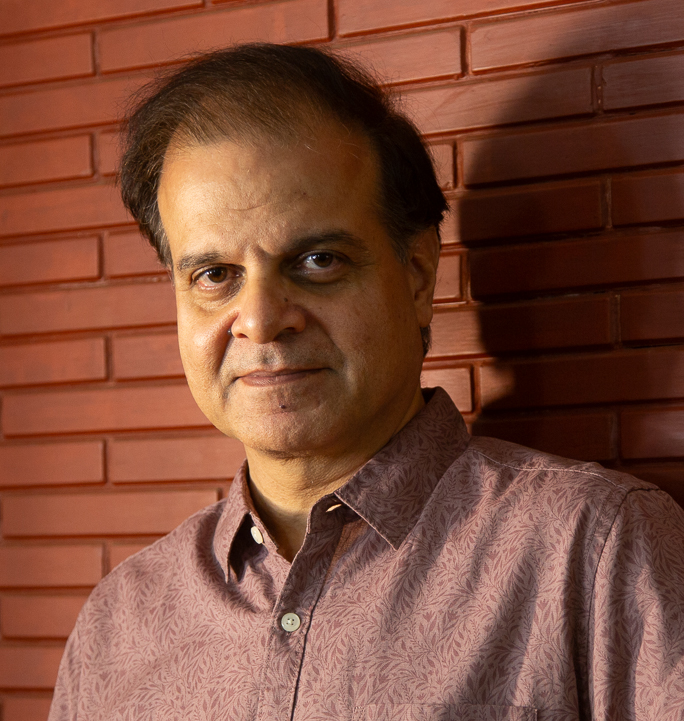
Namit Arora is a writer, humanist, social critic, and travel photographer. He grew up in Gwalior—known for its historic fort, its epigraphic evidence of zero, and Tansen. His proximity to zero—or shunya, zilch, nada—is a great source of pleasure to him. After IIT Kharagpur and a masters in computer engineering from Louisiana, he worked in Silicon Valley for two decades, at both failed startups and big corporations. Whether this made him any wiser is debatable, but it did allow him to take social science courses of dubious practical value at Stanford and to live, work, or travel in scores of countries, with yearlong stints in London and Amsterdam. He quit this profession in 2013 for a life of reading and writing and returned to India. For two years, he volunteered with the Delhi govt. to tackle civic problems; he led the drafting of Delhi’s solar energy policy and a task force on air pollution.
Namit’s writing has appeared in 3 Quarks Daily, The Caravan, The Baffler, The Wire, The Humanist, Philosophy Now, The TLS, The Philosopher, Scroll, Himal, and many anthologies (see his article archive and favorite books). He won the 3QD Arts & Literature Prize in 2011. For two years, 2004–06, he took time off to travel across India and began a photojournal that he has continued to evolve. His photos have been licensed by over 15 museums, 40 academies, and 60 publishers. His videography includes River of Faith, a documentary on the Kumbh Mela. He taught at the Adianta School for Leadership & Innovation, and spoke at Nirmukta Thinkfest 2015 and TEDx Gurugram 2016.

Namit has authored four books: (1) Speaking of History: Conversation about Indian’s Past and Present (with Romila Thapar), (2) Indians: A Brief History of a Civilization, (3) The Lottery of Birth: On Inherited Social Inequalities, and (4) the novel A California Story (US) / Love and Loathing in Silicon Valley (India). In 2024, he wrote and anchored Indians, a history web series in ten episodes. He is on Twitter, Facebook, YouTube, and Email.
Recent Posts from Author
-
No Small Mercy
A powerful story of how a Rwandan genocide survivor made peace with the man who almost killed her (via 3QD, read the discussion there):
 One day, Emmanuel brought some sorghum beer and some sweet potatoes to the field where we volunteered… He started by grilling the potatoes; he took the biggest one and gave it to me, saying, “This is for our secretary.” We all drank and danced.
Then he asked if he could talk to me. “I have something to tell you,” he said. “I have a big problem.” He kept repeating this. “I have a big problem, I have a big problem.” After twenty minutes, he fell on his knees and asked me to forgive him.
Category: CultureLove After Love
(A Poem by Derek Walcott)
 The time will come
when, with elation
you will greet yourself arriving
at your own door, in your own mirror
and each will smile at the other’s welcome,and say, sit here. Eat.
You will love again the stranger who was your self.
Give wine. Give bread. Give back your heart
to itself, to the stranger who has loved youCategory: Fiction & PoetryAmerica, the Cold War, and the Taliban
(Cross-posted as my fourth column on 3QuarksDaily)
 The US pulled out of Vietnam (video) in 1975 after more than a decade and a humiliating defeat. The war had been expensive, the draft unpopular, and too many white boys had come home in body bags. A strong antiwar mood had set in amidst the public and the Congress. Most Americans now believed it was never their war to fight. The Nixon Doctrine held that “Asian boys must fight Asian wars.”[1] At least in the short term, direct military engagement in the third world seemed politically unviable for any US administration.
Vietnam: American Holocaust
I came across this 2008 documentary film made by Clay Claiborne and narrated by Martin Sheen, Vietnam: American Holocaust. Below is a short excerpt (9 mins); the entire film (87 mins) is online here. It contains some of the most horrifying and disturbing war footage I have ever seen. The oddly persistent idea that the United States was/is a “benevolent hegemon” seems utterly depraved in light of this. While at it, also check out this archival footage of a Napalm air attack on a Vietnam village. Be warned: you may need a stiff drink afterwards.
State of Emergency
Moni Mohsin’s brief but compelling history of modern Pakistan:

Pakistan’s problems are not new. Established in 1947 as a homeland for the Muslims of the Subcontinent, its Islamic and secular identities have been in conflict ever since. In Pakistan’s sixty–year history, a corrupt, self–serving ruling class of land owners; a crooked bureaucracy; a boom–and–bust economy; long–simmering tensions with India over Kashmir; and a huge, powerful army that regularly enlists in coups have repeatedly thwarted progress. I do not recall a sustained period of peace, stability, and prosperity during my lifetime.More here. (via 3QD)
Free Market Prisons

Ever heard of the Corrections Corporation of America, “the nation’s industry leader of privately-managed corrections solutions for federal, state and local government”? Traded on the NY Stock Exchange, it runs “more than 64 correctional facilities and detention centers from coast to coast, in small cities, metropolitan areas and destinations in between” in 21 states. As one might guess, the interests of its shareholders are singularly aligned with — you guessed it — growth in the number of prisoners. Each quarter, its financial results report key metrics like the growth of inmate populations and the number of new beds placed into service. If these numbers fall, the stock price falls. That’s no good for a corporation, is it?The land of the free already incarcerates 2.2 million people, or 1% of its adult population (the highest rate in the world; five times higher than in W. Europe and twice as high as in Singapore, which is infamous for its spartan legal system). British columnist George Monbiot describes what tends to happen when the prison industry becomes part of the free market system:
It’s a staggering case; more staggering still that it has scarcely been mentioned on this side of the ocean. Last week two judges in Pennsylvania were convicted of jailing some 2000 children in exchange for bribes from private prison companies.
Asian Food for Thought
 Growing up in India, I ate meat only a handful of times until I left home for college. My mother, a moderately pious Hindu, had a deep aversion to eating animals and wouldn’t allow meat in her kitchen (I also remember her kindness and sympathy towards the ragged animals that shared our city streets: cows, dogs, horses, goats, cats, donkeys, and even occasional elephants and camels). My father was vegetarian for the most part, except when, on rare occasions, he pretended to enjoy a few morsels of meat. I think he did this despite himself, mostly to project the public image of an adventurous, cosmopolitan man. If no one were looking, I’m sure he would have picked a vegetarian option nine times out of ten.
 I only ate meat when my older sister brought home a chicken or mutton dish from a friend’s place, or cooked it herself on a Sunday morning on a kerosene stove in our courtyard. When she cooked, my task was to procure the meat. I would bike up to the butcher’s shop and await my turn, squeamishly eyeing the goat carcasses hanging on hooks, and gallantly ask the man for ‘the best cuts,’ to which he always replied, ‘only the best for you, son.’ Washing and cleaning the meat, I felt a strange exhilaration—I saw it not as food but as the flesh and bone of a dead animal, hacked to bits just hours ago. Mother allowed my sister to use only the most beaten down utensils from her kitchen and later instructed the maid to scrub them clean thrice as long.
Still, my parents encouraged us to eat meat, holding it to be salutary for growing kids. Their attitude later struck me as similar to Gandhi’s during his early struggle and experimentation with eating animals. Gandhi saw meat as a contributor to the enviable vigor, material progress, and sturdier physiques of people from the West, which conflicted with his own traditional disposition—and of his social class—against eating meat.
Wired for War
Amy Goodman in conversation with PW Singer, author of Wired for War: The Robotics Revolution and Conflict in the 21st Century.
An amazing revolution is taking place on the battlefield, starting to change not just how wars are fought, but also the politics, economics, laws, and ethics that surround war itself. This upheaval is already afoot — remote-controlled drones take out terrorists in Afghanistan, while the number of unmanned systems on the ground in Iraq has gone from zero to 12,000 over the last five years. But it is only the start. Military officers quietly acknowledge that new prototypes will soon make human fighter pilots obsolete, while the Pentagon researches tiny robots the size of flies to carry out reconnaissance work now handled by elite Special Forces troops.Wired for War takes the reader on a journey to meet all the various players in this strange new world of war: odd-ball roboticists working in latter-day “skunk works” in the midst of suburbia; military pilots flying combat mission from their office cubicles outside Las Vegas; the Iraqi insurgents who are their targets; journalists trying to figure out just how to cover robots at war; and human rights activists wrestling with what is right and wrong in a world where our wars are increasingly being handed over to machines.
Part 2 of 2 here.
The View from Gaza
Here is an outstanding documentary by Al Jazeera reporters Ayman Mohyeldin and Sherine Tadros, who were in Gaza during the recent Israeli-Palestinian war. Watch it for a glimpse of how the brutal Israeli assault was experienced by ordinary Palestinians (~45 mins; via 3QD).
Being Liberal in a Plural World
 Last month I started writing a guest column on 3QuarksDaily every fourth Monday. My second article, Being Liberal in a Plural World, appeared there today (included below). It synthesizes a number of my earlier posts on topics like human rights, Asian values, pluralism, relativism, and liberalism. The inaugural article was Marco Polo’s India.
Dreyfus on Heidegger
 Heidegger’s Being and Time is among the most profound philosophical works of the 20th century, but the man retains a controversial image—a cold genius without heart or fellow feeling, and a great capacity to delude himself (despite the centrality he placed on “authenticity” in his magnum opus). One might even forgive his anti-semitism, intellectual support of Hitler, and membership of the Nazi party to its very end, were it not for his perverse lack of an apology or remorse later in life (d. 1976). Indeed, he does violence to the literal meaning of the term ‘philosopher’, i.e., ‘lover of wisdom’. Notably, Heidegger’s works also happen to be utterly devoid of ethical concerns, preoccupied as he was with “pure insight”.
And insight he had aplenty, leading to a revolutionary new way of thinking about how human beings are related to the world. Interest in Heidegger has grown enormously in recent decades, starting with attempts to rehabilitate him by none other than Hannah Arendt, his former student and a Jew who fled Nazi Germany and later migrated to the US, and with whom he once had a passionate affair (read Mark Lilla’s article in the NYRB on this astonishing story—subscription is required; psssst! email me if you want the article’s text). But for an overview on Heidegger first, check out this BBC film on his life and philosophy, which also talks about his relationship with Arendt: clip1, clip2, clip3, clip4, clip5, clip6.
Here is an illuminating talk from the early 80s between Bryan Magee and Hubert Dreyfus, a leading Heidegger scholar from UC Berkeley. The conversation traces the roots of existentialism from Husserl, to his pupil Heidegger, to the “brilliant misunderstanding of Heidegger” by Sartre (and his waning reputation), to Merleau-Ponty, to Heidegger’s enormous impact on almost every contemporary academic discipline. The talk is spread over five clips: clip1, clip2, clip3, clip4, clip5 (clip1 shown below).
Searle on Wittgenstein
In this video (likely from the early 80s), Bryan Magee talks to John Searle about the ideas and legacy of Ludwig Wittgenstein, who I’d say is among the top three western philosophers of the 20th century to have influenced me most (besides Foucault, who could be seen as “applied Heidegger,” and Berlin). This relatively accessible conversation covers Wittgenstein’s early work, the Tractatus, as well as his posthumously published, Philosophical Investigations. The talk is spread over five clips of about 7-10 minutes each: clip1, clip2, clip3, clip4, clip5. Enjoy.
Who Speaks for Islam?
Here is an interesting debate between two Muslim women in the US: Irshad Manji and Dalia Mogahed. Manji, a vocal critic of Islam, sees herself as a reform Muslim; it is easy to understand why young Muslims in the West, as well as those fearful of Islam, would be drawn to her. Mogahed identifies herself as a mainstream Muslim who is “passionate about moderation.”
I found Mogahed’s analysis of the Muslim world more illuminating, including her response to whether Islam is a religion of peace, and how radicalization is so often rooted in politics but then takes on the language of religion. I did squirm a bit when she referred to Prophet Muhammad’s wars of conquest as models of just wars. She also showed remarkably little enthusiasm for ijtihad—even when led by qualified Muslim clerics—rooting instead for classical religious scholarship and its more liberal interpretations of Islamic faith and jurisprudence.
Where the Hell in KGP?
As many readers of this blog know, I went to the Indian Institute of Technology, Kharagpur (IIT, KGP) in West Bengal. Years later I visited my alma mater again and wrote about it here. Guess what I found today? Those familiar with Matt Harding’s heartwarming dance videos from around the world (Where the Hell is Matt?) will likely relate to what it has inspired the students of IIT KGP to do. (via Pran)
The soundtrack is the same as in Matt’s video — a Bengali poem written by Tagore (Praan, or “Stream of Life”) and turned into song by composer Garry Schyman and Bangladeshi-American Palbasha Siddique.
Stories from China
Three audio stories from the New China that first aired in the US on the National Public Radio in June, 2008, and did so again recently.
Journalism With Chinese Characteristics
“There is real investigative reporting in China, it’s just not done under a free press flag. Instead, practitioners mind an unstated set of rules, keeping themselves safe by employing tactics like using excessive jargon and exploiting government rivalries. It’s an evolving dance requiring ingenuity, subtlety, courage and a willingness to be fired every day. Plus, a conversation with the former host of ‘At Night You’re Not Lonely,’ a call-in radio show that dispenses hard-won wisdom to the factory girls of Shenzhen, a city in flux.”

China Vision
“How the world sees China, and how China thinks it is seen by the world may make all the difference as time marches on. The West cannot afford to hold on to kung fu, Confucius, and chopsticks as our big ideas about China. Modern art, fashion, and the young urban elite have a new story to tell; if anyone’s listening. Plus, Brooke talks with the author of “Wolf Totem,” a best-selling novel and Chinese conversation piece about resisting and revering Mongolian wolves during the Cultural Revolution.”
Category: CultureMarco Polo’s India
 Returning home from China in 1292 CE, Marco Polo arrives on the Coromandel Coast of India in a typical merchant ship with over sixty cabins and up to 300 crewmen. He enters the kingdom of the Tamil Pandyas near modern day Tanjore, where, according to custom, ‘the king and his barons and everyone else all sit on the earth.’ He asks the king why they ‘do not seat themselves more honorably.’ The king replies, ‘To sit on the earth is honorable enough, because we were made from the earth and to the earth we must return.’ Marco Polo documented this episode in his famous book, The Travels, along with a rich social portrait of India that still resonates with us today:
 The climate, he finds, is so hot that all men and women wear nothing but a loincloth, including the king—except his is studded with rubies, sapphires, emeralds and other gems. Merchants and traders abound, the king takes pride in not holding himself above the law of the land, and people travel the highways safely with their valuables in the cool of the night. Marco Polo calls this ‘the richest and most splendid province in the world,’ one that, together with Ceylon, produces ‘most of the pearls and gems that are to be found in the world.’
 On Pluralism, Relativism, Liberalism
 On her delightful blog recently, Peony, holding forth on the topic of human rights and defending the “Asian Values” side of the debate (also see 1, 2, 3, 4), posed a bold question that both irked and challenged me: under what authority is “the right to gather or the right of free speech … more fundamental … than say the right for clean water and nutritious food”? This is an attempt to answer her question.
 ***
A great many of us today are “value pluralists“,
i.e., we believe that humans live by many legitimate ethical values and
choices: adopting a baby or making one, joining the Resistance or
caring for a sick mother, socialist democracy or capitalist oligarchy.
We may not endorse all values equally, but we hold them legitimate in
the sense of being recognizable human values—in other
circumstances, we can imagine ourselves, or our friends, embracing
those values.The Death of a Salesman
Yes, I too had that youthful phase when I dabbled in poetry. From 17 to 27, I too wrote imaginary heartbreak poems, gooey lovesick poems, metaphysical angst poems, faux disenchanted poems, pseudo-sophisticated poems, aloof ironic poems, woo-the-maiden poems, voluptuous sorrow poems. Most that survive I can scarcely read now without wincing, but I cannot bring myself to delete them from my computer (they are safely encrypted though—without my consent, they are like ashes in the fireplace!). Below is one I still like enough; I wrote it in an office cube and it’s from the tail end of my poetic phase. Not that poetry has gone out of my soul; I think it has found home elsewhere in my imagination. 🙂
 The Death of a Salesman
One fine morning, the salesman died,
an event well beyond his foresight.
Death would come one day, he felt sure,
but to him after the others,
for he believed in his exemplary life,
in the larger human cause,
not just his own, as his critics surmised.Category: Fiction & PoetryThe Eichmann Within

Hannah Arendt‘s landmark Eichmann in Jerusalem documents the trial of Adolf Eichmann, a Nazi nabbed by the Israeli secret police in Argentina and brought to Jerusalem, where he was tried and executed. Arendt’s clear-eyed reportage covered a good deal of the historical and moral territory of the Holocaust. By peering into the heart of a man and a system held synonymous with evil, she examined the very notion of the word: What exactly is the face of evil?I’ve also watched (twice) Eyal Sivan’s documentary on the trial of Eichmann, The Specialist, much of it courtroom drama that sheds powerful light on the man. Eichmann emerges as a self-absorbed mid-level bureaucrat, neither intelligent nor reflective, devoid of courage, deferential to authority, eager to please his bosses and quick to take pride in a job done well, and with no special antipathy towards Jews. Indeed, he seems quite ordinary in his insecurities, sentimentality, and the capacity to delude himself about his responsibility for the suffering of others.
Arendt’s analysis of the banality of evil led Stanley Milgram to devise his now famous experiment to study the harm most ordinary people would willingly (without coercion) do to their fellow humans under a different configuration of power and authority. This is what he found: