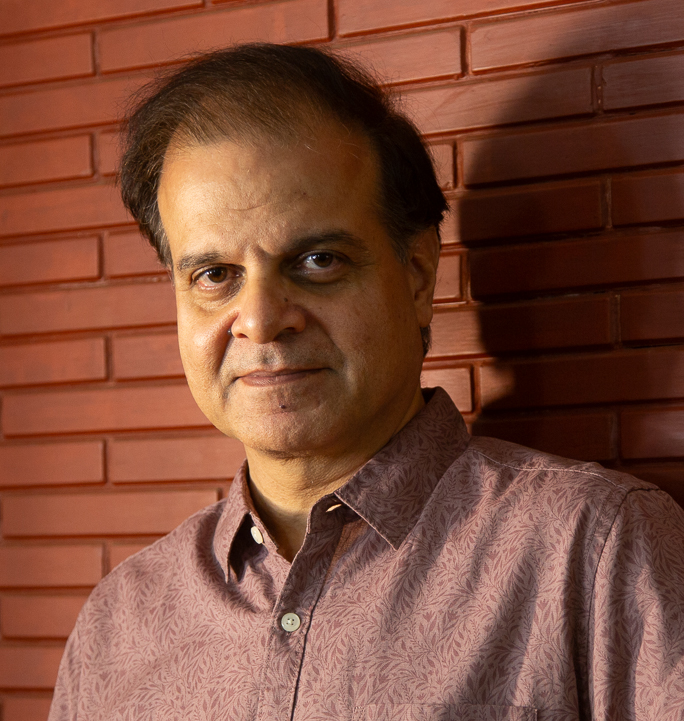
Namit Arora is a writer, humanist, social critic, and travel photographer. He grew up in Gwalior—known for its historic fort, its epigraphic evidence of zero, and Tansen. His proximity to zero—or shunya, zilch, nada—is a great source of pleasure to him. After IIT Kharagpur and a masters in computer engineering from Louisiana, he worked in Silicon Valley for two decades, at both failed startups and big corporations. Whether this made him any wiser is debatable, but it did allow him to take social science courses of dubious practical value at Stanford and to live, work, or travel in scores of countries, with yearlong stints in London and Amsterdam. He quit this profession in 2013 for a life of reading and writing and returned to India. For two years, he volunteered with the Delhi govt. to tackle civic problems; he led the drafting of Delhi’s solar energy policy and a task force on air pollution.
Namit’s writing has appeared in 3 Quarks Daily, The Caravan, The Baffler, The Wire, The Humanist, Philosophy Now, The TLS, The Philosopher, Scroll, Himal, and many anthologies (see his article archive and favorite books). He won the 3QD Arts & Literature Prize in 2011. For two years, 2004–06, he took time off to travel across India and began a photojournal that he has continued to evolve. His photos have been licensed by over 15 museums, 40 academies, and 60 publishers. His videography includes River of Faith, a documentary on the Kumbh Mela. He taught at the Adianta School for Leadership & Innovation, and spoke at Nirmukta Thinkfest 2015 and TEDx Gurugram 2016.

Namit has authored four books: (1) Speaking of History: Conversation about Indian’s Past and Present (with Romila Thapar), (2) Indians: A Brief History of a Civilization, (3) The Lottery of Birth: On Inherited Social Inequalities, and (4) the novel A California Story (US) / Love and Loathing in Silicon Valley (India). In 2024, he wrote and anchored Indians, a history web series in ten episodes. He is on Twitter, Facebook, YouTube, and Email.
Recent Posts from Author
-
Thomas Nagel on TM Scanlon
Sifting through my bookmarks, I ran across Nagel‘s review of T.M. Scanlon‘s What We Owe to Each Other, and read it profitably once again:

On occasion we are faced with acute moral choices – whether to join the Resistance or stay at home and care for our widowed mother; whether to run off with Vronsky or remain with Karenin. But largely, morality shapes our lives in ways we don’t even think about, in fact it does so partly by excluding certain options from our thoughts. Most of us, for instance, wouldn’t even consider (a) threatening to expose a colleague’s adulterous affair to his wife unless he votes our way on a contested appointment or policy issue; (b) extracting some cash from the pocketbook of an interior decorator as she inspects our house, because we think she is overcharging us; (c) stealing a kidney for a friend who needs a transplant; (d) selling all we have and giving it to the poor. It isn’t that we weigh the pros and cons and determine that the cons outweigh the pros. These things are not on the menu of options among which we feel we must choose. Such exclusions, as well as restrictions on what may legitimately be taken into account in some decisions but not others (prohibitions against nepotism, for instance), typify the complexity of moral standards and suggest that an accurate account of morality and its role in life will not be simple.Thomas Scanlon’s understanding of this complexity and of its sources in the variety of human relations and values is one of the virtues of this illuminating book…. The book is about morality rather than politics, though its general method can be applied to the political domain, where some of the most heated moral arguments and controversies take place. Recent work in political theory is more widely known, but moral philosophy has been an intensely active field over the past three decades, and Scanlon’s theory addresses a number of its central questions: first, the question of the objectivity or truth of moral claims, their relation to reason, and whether or not they should be regarded as in some sense relative or subjective; second, the question of the kind of concern or respect for persons that is at the foundation of morality – what kinds of motive it calls on when it requires us to forgo certain means that would advance our personal aims, and how much it can ask that we sacrifice for the sake of others; third, the question of how, and to what extent, individual rights, liberties and prerogatives are morally shielded from encroachment in the name of the general good; fourth, the question whether modest advantages to each of a large number of people can be aggregated to outweigh a large cost to each of a much smaller number, for purposes of moral justification – a besetting problem for the intuitive acceptability of utilitarianism.
-
On China’s Confucian Revival
Timothy Cheek reviews Daniel A. Bell‘s new book, China’s New Confucianism: Politics and Everyday Life in a Changing Society (chapter one):
-
India’s Dangerous Divide
Ramachandra Guha in the Wall Street Journal:

If the first tragedy of the Indian Muslim was Partition, the second has been the patronage by India’s most influential political party, the Congress, of Muslims who are religious and reactionary rather than liberal and secular. Nehru himself was careful to keep his distance from sectarian leaders whether Hindu or Muslim. However, under the leadership of his daughter, Indira Gandhi, the Congress party came to favor the conservative sections of the Muslim community. Before elections, Congress bosses asked heads of mosques to issue fatwas to their flock to vote for the party; after elections, the party increased government grants to religious schools and colleges. In a defining case in 1985, the Supreme Court called for the enactment of a common civil code, which would abolish polygamy and give all women equal rights regardless of faith — the right to their husband’s or father’s property, for example, or the right to proper alimony once divorced. The prime minister at the time was Rajiv Gandhi. Acting on the advice of the Muslim clergy, he used his party’s majority in Parliament to nullify the court’s verdict. After Rajiv’s widow, Sonia Gandhi, became Congress president in 1998, the party has continued to fund Muslim religious institutions rather than encourage them to engage with the modern world.More here. Also check out Guha’s conversation with Charlie Rose.
-
Candles in the Dark?

Beyond Belief, an annual symposium that seeks to promote the constituency of reason in society, was held this year from October 3-6 in La Jolla, CA. One weekend recently, I watched all 44 of its talks and panel discussions now available online (each about 25-30 mins). The theme this year was Candles in the Dark. Participants were asked “to propose a Candle — a potential
solution to a problem that they have identified in their area of
expertise or informed passion.” The symposium was organized around sessions that focused on science’s contribution to five human preoccupations: politics, morality, happiness, money, and law.If the anthropologists stole the show in 2006, this year belonged to the lawyers, or rather law academics who actively seek to incorporate science in their methods. By far the smartest group of people in
the room, they evinced the most nuanced understanding of the difference between science and metaphysics in general, and the limits and ethical implications of neuroscience research on criminal law, in particular. Other presentations I enjoyed came from Jonathan Haidt, Beatrice Golomb (her animated talk on how money is corrupting medical research was also the scariest), Philip Zimbardo, and Jonathan Glover. Strategies for promoting science in the public sphere—via Washington lobbies, media outreach—were presented and debated but only peripherally mentioned was the one I think can make a more fundamental impact: a “next-generation Carl Sagan” to seduce young minds by showing them the wonder and power of science, using the best available multimedia and teaching aids.The least inspiring session was the opening one on Human Flourishing/Eudaimonia. Disquisitions on happiness somehow managed to neither define happiness, nor how to measure it. Individual speakers who irked me the most included Patricia Churchland, a snake oil seller at the crossroads of neuroscience and philosophy, and whose thesis was effectively destroyed by a sharp observation from Nita Farahany, a lawyer; Sam Harris, the Dick Cheney of the symposium, who understands neither science nor religion but is wholly unaware of it. Why does he get invited every year? For the tawdry drama he adds to the proceedings? Peter Atkins, a textbook example of what a scientist without humility can become. Last year he fatuously proclaimed the impending demise of philosophy and the coming reign of science, adding that “We’ve got to get rid of philosophy because it is really such a ball and chain on progress … a philosopher is really just a nuisance.” Choosing Atkins to end the symposium with his talk was a real downer.
-
Views on Mumbai Terrorism
 In this past week since terrorists struck Mumbai, a lot of Indians have poured their hearts out in newspapers, magazines, and blogs. A lot of their writings are angry, hawkish, and nationalistic; many are gushing, mawkish, and oozing with purple prose; a handful offer vignettes of courage or heartfelt pain. Below are some of the more significant and less popular viewpoints I’ve encountered:
 Enough is Enough by Badri Raina:
“As I have listened to the outrage pouring out from a diverse assortment of some celebrity Mumbai citizens whose haunts habitually remain restricted to the affluent South Mumbai—a zone of peace and prosperity that has had its first rite of passage to the ugliness that afflicts the rest of the city, indeed the rest of India, and rest of the world—I find myself asking the question “who is it saying ‘enough is enough’, to whom, and why now”?” (thanks to Ruchira Paul)
-
A Poll for You News Junkies

Here is a thought experiment for the readers of Shunya’s Notes. Let’s say you have been cut-off from all news for a long weekend and have just been informed that 200 people died in India yesterday from a single event. The only other detail given to you is that the event is one of the following:- A bubonic plague in the city of Nagpur.
- Indiscriminate bomb blasts/shootings by Pakistani terrorists in Mumbai.
- A Naxalite guerrilla attack in Chattisgarh against the police and “class enemies”.
- Shortly after takeoff, a plane crashes outside Chennai.
- Food poisoning at a big marriage party in Trivandrum.
- Indiscriminate bomb blasts/shootings by Indian Muslim terrorists in Mumbai.
- A Hindu-Muslim communal riot in Hyderabad.
- A levee breach that floods and drowns a few villages in Bihar.
- A Hindu pogrom against Muslims in Ahmedabad with tacit support from government officials.
- A chemical industrial disaster in Kanpur (poisonous gas leakage).
Reorder the list such that 1 is the event you find most upsetting,
10 the least (yes, they’re all upsetting but some more than others, right?). I have used copy/paste to create mine
in the first comment; add yours too — but don’t look at mine just yet; finish your own ordering first!(Photo: “India: Liberty and Death” Time
Magazine Cover, October 27, 1947.)Category: Daily Noise -
The Morality of Human Rights

Is “human rights” a Western concept? I’d say, yes and no. Yes because the modern concept of human rights arose in the West during the Enlightenment. No because it is only the latest episode in the long human preoccupation with justice, compassion, and many localized personal and communitarian rights. The current edifice of human rights adopted by the UN rests on the idea of moral reciprocity—that others too never wish to be abused in mind or body—variously evident in all human societies.But consensus on precisely what rights all humans deserve in a world with a diversity of histories, is far from settled (recall the “Asian values” debate?). This sometimes causes much acrimony, with critics calling human rights a tool of western hegemony aimed at non-Western societies, only to be accused in return of undermining liberty in the name of culture, order or tradition.
I think the question that underlies all debate on human rights is this: Is there a set of ideas, beliefs, values—a secular morality and the institutions to safeguard it—that ought to be promoted universally, and the rest left alone in the interests of truth, negative liberty, and diversity? To better understand how various approaches here relate to each other, I’ll first define three contending visions of morality:
-
The Social Virus of Terrorism
In early 2006, I was on a train to Varanasi when my mother called. Muslim terrorists had struck Varanasi, she said, including its train station. Every news channel on TV was talking about it. She advised me to postpone the visit and get off earlier. Besides Usha, I had with me two American friends on their first trip to India, and I felt responsible for their safety. I had to act fast. What if Hindu-Muslim riots break out? The reality of the situation sunk in further when an NDTV reporter and her camera crew got on the train. With time to kill before Varanasi, she went around in the hyper-excited voice I had begun to associate with live reporters in India, quizzing passengers about their thoughts on the incident.
I persuaded my fellow travelers to continue. The terrorists had done their deed already; worst case, we could stay holed up in our hotel. We found a part of the Varanasi station cordoned off by the police. I could see blotches of red on the ground. The driver of the taxi we took into town had witnessed the explosions—flying body parts, screams, the ensuing melee. Our decision turned out to be a good one—the city remained calm and we moved around freely. I felt proud of my fellow citizens for their mature response to the situation.

The term “social virus” is often used to describe modern terrorism of the kind that happened in Varanasi and yesterday in Mumbai (vs. terrorism that is rooted in well defined political/military struggles, such as for a disputed homeland). I think this descriptor is sensible. Like other social viruses, this one too afflicts the social body indiscriminately and arises out of ill-defined or unaddressable grievances. -
Sita Sings the Blues
Sita Sings the Blues is a Ramayana-inspired animated film told from the standpoint of Sita, who is depicted as an Indian Betty Boop. It is written, produced, designed, and animated by Nina Paley (I haven’t seen it yet but the concept is intriguing, as is the way Paley came to it).

Sita is a goddess separated from her beloved Lord and husband Rama. Nina is an animator whose [American] husband moves to India, then dumps her by email. Three hilarious shadow puppets narrate both ancient tragedy and modern comedy in this beautifully animated interpretation of the Indian epic Ramayana. Set to the 1920’s jazz vocals of Annette Hanshaw, Sita Sings the Blues earns its tagline as “The Greatest Break-Up Story Ever Told.”Category: Art & Cinema -
Two Argumentative Indians
I came across an interesting, if also long and meandering, e-debate from early 2004 between two Indians in the US: Rajiv Malhotra and Vijay Prashad. The debate spans several topics in the history, culture, and politics of South Asia and their representation on Western campuses.

Rajiv Malhotra is a public intellectual and philanthropist with a strong pro-India Hindu perspective (but non-Hindutva). He has used his financial success in the hi-tech industry to fund academic research and conferences led by Indian scholars, and seeks to restore balance to the study of Indian culture and Hinduism in the West. He runs The Infinity Foundation and is the author of Invading the Sacred: An Analysis of Hinduism Studies in America.
Vijay Prashad is George and Martha Kellner Chair in South Asian History and Professor of International Studies at Trinity College, CT. According to his faculty profile, he is committed to intellectual
extremism: nothing is forbidden to think about, everything is open to
investigation. Known for his outspoken leftist writing and activism, he is the author of eleven books, including The Darker Nations: A People’s History Of The Third World.Category: Books & Authors -
The Global Gender Gap

The World Economic Forum has released its 2008 gender gap report and ranked 130 countries on it. The gap index measures “gender-based inequalities on economic, political, education- and health-based criteria” and is “designed to measure gender-based gaps in access to resources and opportunities” (not absolute levels of available resources and opportunities). The index is therefore independent of a country’s development level (here is the methodology).- Northern Europeans once again lead the pack: Norway, Sweden, Finland. Must be that reddish brew of euro-socialism they add into their waterworks. Or as Usha quipped, “It’s so bloody cold out there, they have nothing better to do than to fix their societies.”
- Gender gap correlates much less with a country’s economic development rank, more with affirmative action and traditional culture (which can deal a fairer hand to women). For e.g., Philippines ranked 6, Sri Lanka 12, Lesotho 16, Mozambique 18, South Africa 22, Cuba 25, Namibia 30, Tanzania 38, while the US was 27, Israel 56, Italy 67, Singapore 84, Japan 98, and S. Arabia 128.
- China ranked 57, far above India at 113 and Pakistan 127. Next time someone cites female prime ministers as evidence of women’s high status in the subcontinent (vs., say, the US, which has never elected a female head of state), cite this study. No wonder more Indian women than men recoil at the idea of returning to India after living in the West.
-
Buruma on French’s Naipaul

The lives of writers are a legitimate subject of inquiry; and the truth should not be skimped. It may well be, in fact, that a full account of a writer’s life might in the end be more a work of literature and more illuminating—of a cultural or historical moment—than the writer’s books. [–VS Naipaul]
Category: Books & Authors -
Indian Vistas: A Calendar

Indian Vistas — 2009 Calendar by Namit Arora (US$16 + S&H)A couple of friends recently suggested that I make calendars out of my travel photo archive on Shunya. So I made one! The effort was a breeze; the hardest part was choosing the 12 images (click to preview).
The new year is a-comin’. Go ahead, buy one! All proceeds will go to Medecins Sans Frontieres (MSF).
Category: Photography -
The American Electorate, 2008
 Yesterday was a very happy day for me because Barack Obama won, beating John McCain 52-46 in the popular vote. That it took the biggest financial crisis since the Great Depression, a botched war in Iraq, a deeply unpopular Republican administration, Sarah Palin, and Obama’s far superior intellect, curiosity, vision, heart, and political acumen to prevail only by 6% is hardly confidence-inspiring in the American people. But let us be gracious now and savor the victory such as it is—for the chance to have a smarter leader at the helm, for the milestone it is for US Civil Rights and the fulfillment of a powerful dream, and for the improbable journey of this son of a black Muslim man from the third-world.
 From the results of the national exit poll taken yesterday, I have gleaned the following choice bits about the American electorate:
- Women preferred Obama to McCain by a 56-43 margin; men were evenly split.
- Working women preferred Obama 60-39; the rest (men and non-working women) were evenly split.
- Whites (74% of electorate) preferred McCain 55-43 (white men 57-41). Blacks (13% of electorate) chose Obama 94-4, and Latinos and Asians by a two-thirds majority.
- Married people preferred McCain 52-47. Unmarried people preferred Obama 65-33.
- 27% of Lesbian, Gay, Bisexual, and Transgendered people (4% of electorate) voted for McCain.
- Protestants (54% of electorate) chose McCain 54-45. Catholics chose Obama 54-45, Jews 78-21, others (Muslims, Hindus…) 73-22.
- 23% of those who indicated their religion as “none” (atheists? 12% of electorate) voted for McCain.
- A quarter of the electorate identified themselves as White Evangelical/Born-again Christians. A quarter of them voted for Obama.
- Support for McCain grew with age but only senior citizens (65+) preferred McCain (so much for associating age with wisdom!).
- Annual family income became a factor only below $50K (60-38 for Obama, though whites in this income group preferred McCain). Above $50K, income was not a factor.
- About 6% of US families make $15K or less annually. About 6% make over $200K.
- Those with zero high school education or post-graduate degrees preferred Obama by around 20 point margins. The gap was much smaller with in-between levels of education. (A little knowledge is a dangerous thing!)
- 22% of people identified themselves as Liberals, 44% as Moderates, 34% as Conservative. Voting for Obama were 90% of the liberals, 60% of the moderates, and 20% of the conservatives.
- 50% of the electorate is “very worried” about the economy and they preferred Obama 60-38.
- A third of the electorate had no investments in the stock market and preferred Obama 61-37; the rest were evenly split.
- 42% of the electorate has a gun at home and they preferred McCain 62-37. The rest chose Obama 65-33.
- Ex-military people preferred McCain 54-44.
- Support for Obama increased moving across rural -> suburban -> urban areas.
- 10% of the people decided who to vote for in the very last week, and then split evenly.
- 28% of the electorate even today approves of the job Bush is doing.
Category: Politics -
On Credit Default Swaps

The recent meltdown in the US financial markets has been attributed to subprime lending practices that, along with low interest rates, had fueled a housing bubble since the mid-90s. In a feeding frenzy of sorts, lenders kept lowering the bar for home mortgages. As adjustable interest rates kicked up, defaults and foreclosures began and the bubble finally burst. Housing demand and prices fell, leading to a liquidity crunch for financial institutions. Thanks to economic globalization, the malaise quickly spread across the pond.Many pundits have adequately explained the crisis (especially listen to George Soros—video below) and why the US government had to devise a massive bailout for Wall Street and recapitalize the banks (think of it as an emergency liver transplant for one who had turned to a reckless, binge drinking lifestyle). It also brought home another fact of modern capitalism: bankruptcy is only for the little folks; those big enough can’t be allowed to fail for their irresponsibility, lest they bring down the whole house. Neat, aye?
But now, having traded a pressing liquidity crisis with a higher national debt, is the worst finally behind us? In other words, do we now simply need to hunker down and ride out an economic recession that may be, at worst, longer than usual (say, lasting up to 18-24 months, instead of the average 10 months) and wait for the eventual market rebound?
Category: Economics -
The Lives of Animals
“Life on the farm isn’t what it used to be. The green pastures and idyllic barnyard scenes portrayed in children’s books have been replaced by windowless sheds, tiny crates, wire cages, and other confinement systems integral to what is now known as ‘factory farming.’” Here is a sobering look at how farm animals are transformed into food today (viewer discretion advised. Also see my previous post on this topic.)
(Click image below to go to the video site. Image source.)

-
Independence for Kashmir?
 Recent events in Kashmir have sharpened the criticism of Indian military’s botched occupation of the region (e.g., Barun Roy, Pankaj Mishra, Pratap Bhanu Mehta), with many in the Indian media even calling for the hitherto unthinkable—Kashmiri independence (e.g., Arundhati Roy, Swaminathan Aiyar, Vir Sanghvi). Here is Ms. Roy:
 None of these fears of what the future holds can justify the
continued military occupation of a nation and a people. No more than
the old colonial argument about how the natives were not ready for
freedom justified the colonial project. … The Indian military occupation of Kashmir makes monsters of us all. It
allows Hindu chauvinists to target and victimise Muslims in India by
holding them hostage to the freedom struggle being waged by Muslims in
Kashmir. It’s all being stirred into a poisonous brew and administered
intravenously, straight into our bloodstream. At the
heart of it all is a moral question. Does any government have the right
to take away people’s liberty with military force?India needs azadi [freedom] from Kashmir just as much—if not more—than Kashmir needs azadi from India.
-
Ten National Security Myths
A special feature in The Nation presents ten national security myths that—to varying degrees—both Obama and McCain are spouting:

As the election draws near, a new set of myths and fallacies as misleading as those that led the Senate to support George W. Bush’s invasion of Iraq have become embedded in our foreign policy discourse. Many of them are being perpetuated by the very same political forces that peddled the myth of mushroom clouds coming from Saddam Hussein’s Iraq. Others are the product of muddled thinking on the part of both Republicans and Democrats. If left unchallenged, these myths and fallacies could influence the outcome of the election and shape policy in the next administration…
Myth 1. It’s a dangerous world. We face an array of serious national security threats that require an experienced Commander in Chief.
Category: Politics -
On Conservative Values
With battle lines clearly drawn in the US, Jonathan Haidt explains what, deep down, separates the Democrats from the Republicans:
 …the second rule of moral psychology is that morality is not just about how we treat each other (as most liberals think); it is also about binding groups together, supporting essential institutions, and living in a sanctified and noble way.
 When Republicans say that Democrats “just don’t get it,” this is the “it” to which they refer. Conservative positions on gays, guns, god, and immigration must be understood as means to achieve one kind of morally ordered society. When Democrats try to explain away these positions using pop psychology they err, they alienate, and they earn the label “elitist.” But how can Democrats learn to see—let alone respect—a moral order they regard as narrow-minded, racist, and dumb?
-
What Confucius Said
(This essay was published in Culture Wars, the reviews publication of the Institute of Ideas, London, in Feb 2009.)
 During the Cultural Revolution, millions of Red Guards rampaged at the behest of Chairman Mao to rid China of its “Four Olds”: old customs, old culture, old habits, and old ideas. They defaced ancient monuments, destroyed historical artifacts, burnt monasteries, persecuted traditional arts, and tortured minorities and “bourgeois thinkers”, leaving half-a-million dead in their wake. A special venom was directed at things Confucian. Encouraged to question their parents and teachers (who were traditionally revered), youngsters were soon marching with slogans like: “Parents may love me, but not as much as Chairman Mao”.
 Regarded later as an unmitigated disaster even by diehard commies, this wasn’t the first time a Chinese leader had turned against Confucianism. The very first emperor of China, Qin Shi Huang, who also commissioned the Terracotta Army, had launched his own great Confucian purge in the third century BCE. But such events are anomalies for Confucianism, which would revive, adapt, and thrive again (the longest slump was during the Tang dynasty), giving China a distinctive cultural continuity for almost 2500 years.